
When Responsibility Becomes Anxiety: Perinatal OCD in High-Achieving Mothers
Women accustomed to being prepared and solving problems may find motherhood's uncertainty particularly difficult. Amber Morris, PsyD, PMH-C, explores how responsibility, perfectionism, and the need for certainty can contribute to perinatal OCD and anxiety.
During my years as a psychologist in the Navy, I worked in environments where preparation, attention to detail, and anticipating risk were essential. In high-stakes settings, these qualities can be incredibly valuable. You learn to identify potential problems, prepare for different outcomes, and take your responsibilities seriously. Working with military mothers taught me something about what can happen when those same instincts are brought into motherhood.
I began to see how difficult it can be for a woman who is used to being prepared and competent to enter a role where no amount of preparation can guarantee that everything will be okay. I now recognize this same pattern in many of the women I work with—physicians, attorneys, executives, academics, entrepreneurs, and other highly responsible women who are accustomed to being the person others rely on. They may have spent years building successful careers, making difficult decisions, and solving complicated problems. They are thoughtful, conscientious, and deeply invested in doing things well.
Then they become mothers, and suddenly there are endless decisions to make and an enormous amount of uncertainty that cannot be solved through better preparation. Am I feeding the baby enough? Was that medication safe during pregnancy? What if I missed something? What if something happens and I don't know about it? What if I'm not doing this right?
For some women, the desire to be a good mother gradually becomes a feeling that they need to do everything perfectly in order to keep their baby safe. The standards they have used to succeed in other areas of their lives can become impossible standards for motherhood. This is where perinatal anxiety and OCD can take hold.
When Being Responsible Starts to Feel Like Being Vigilant
Some degree of vigilance is a normal part of becoming a parent. New parents check on their babies, research questions, and pay close attention to changes in feeding, sleep, development, and health. The problem isn't caring about your baby too much. The problem is when anxiety convinces you that being a good mother means staying one step ahead of every possible danger.
For a woman experiencing perinatal anxiety or OCD, this might look like repeatedly checking the baby monitor, researching a symptom late into the night, asking a partner or pediatrician for reassurance, or going over the same decision again and again because she cannot feel completely certain that she made the right one. It may look like reading every available source about a medication during pregnancy, repeatedly checking whether something is safe for breastfeeding, or feeling unable to make an ordinary parenting decision without first consulting multiple sources.
At first, these behaviors can feel like responsible parenting. I'm just being careful. I'm just making sure. I just want to know that everything is okay.
But eventually, the goal can shift from being informed to feeling certain. And certainty is something anxiety and OCD can keep moving further away.
This can be particularly confusing for high-achieving women because the strategies that are driving the anxiety may be the same strategies that have worked extremely well for them everywhere else. Researching, preparing, anticipating problems, and seeking more information have probably helped them make good decisions throughout their lives. It can be difficult to recognize when those same strengths have crossed over into a cycle that is no longer helping.
Checking and Reassurance Seeking
A mother might check that her baby is breathing repeatedly throughout the night. She might inspect bottles or feeding equipment over and over, repeatedly ask her partner whether the baby feels too warm, or spend hours searching online for information about a symptom. She may know that she has already received reassurance, but still feel compelled to ask again.
The problem isn't the information itself. It is the belief that one more check, one more search, or one more question will finally make the uncertainty go away. For someone who is accustomed to solving problems through preparation and information, this can be a particularly convincing trap.
Over time, the questions may become increasingly specific. Was that cough normal? What if it means something more serious? What if the pediatrician missed something? What if I didn't explain the symptoms correctly? The mother may recognize that she is asking the same question in different forms, but still feel unable to stop until she feels completely reassured.
Unfortunately, complete reassurance rarely lasts.
Intrusive “What If” Thoughts
Perinatal OCD can also involve sudden, unwanted thoughts or images about something terrible happening to your baby. A mother might have an intrusive thought about dropping the baby down the stairs, someone hitting their car, the baby dying in their sleep, or accidentally hurting the baby herself.
These thoughts can be especially frightening because they often feel completely inconsistent with what a mother wants. She may start wondering why she had the thought in the first place or what it says about her that her brain produced it. Would I really have this thought if I were a good mother? Why can I picture this so clearly? What if having the thought means something about me?
An intrusive thought is not an intention or a prediction, and having a disturbing thought does not mean you want it to happen. In fact, OCD often targets the things we care about most.
The difficulty comes when the thought is interpreted as meaningful or dangerous and the mother begins trying to prevent, neutralize, or gain certainty about it. She may start monitoring herself more closely, avoiding situations that trigger the thought, seeking reassurance that she would never act on it, or mentally reviewing what happened to make sure she is a good and safe mother.
Avoidance and Mental Rituals
Not every compulsion is visible. A mother might avoid carrying her baby down the stairs because she is afraid of having an intrusive thought, avoid driving with her baby, or feel unable to be alone with the baby. She might repeatedly replay the day in her mind, trying to determine whether she said or did something that could have caused harm.
These behaviors can be difficult to recognize as compulsions because they can look like caution or responsibility. But if the goal is to eliminate uncertainty or make absolutely certain that nothing bad will happen, they can become part of the OCD cycle.
Sometimes the mental rituals are even harder to identify. A mother may spend hours analyzing whether she felt the “right” amount of love when she looked at her baby, reviewing whether she responded appropriately to a crying infant, or mentally comparing her experience of motherhood to what she thinks other mothers are feeling. The content can change, but the underlying question remains the same: Can I know for certain that I am doing this right?
When Preparation Can't Solve Uncertainty
One of the things my military experience taught me is that preparation can be incredibly adaptive. Checklists, contingency plans, repetition, and attention to detail can help people function effectively in high-stakes environments. But motherhood introduces a kind of uncertainty that preparation cannot eliminate.
You can follow every recommendation and your baby can still get sick. You can make a careful decision and later wonder if another decision would have been better. You can research the safest car seat, follow every sleep recommendation, choose the healthiest foods, and do everything you reasonably can to protect your child—and still not be able to guarantee what happens next.
For someone who has spent years being rewarded for being prepared, responsible, and capable, that can be incredibly uncomfortable. When uncertainty feels intolerable, trying harder can feel like the obvious solution. So you research a little more, check one more time, ask your partner, call the pediatrician, or replay what happened in your mind. You try to make sure.
The problem is that the relief that comes from checking or reassurance can actually strengthen the cycle. Your brain learns that the anxiety required a response—that the threat must have been important because you took action to neutralize it. Over time, the goal can become less about caring for your baby and more about getting rid of the feeling that something might be wrong.
This is one reason perinatal OCD can be so difficult for highly responsible women to recognize in themselves. The behaviors can look like conscientiousness from the outside. From the inside, they can feel like the only responsible thing to do.
From “Perfect” to “Good Enough”
Treatment for perinatal anxiety and OCD isn't about becoming careless or ignoring legitimate concerns. It isn't about convincing yourself that nothing bad will ever happen, and it isn't about eliminating every scary thought. Instead, treatment involves learning to respond differently to uncertainty and intrusive thoughts.
Part of that process is learning to recognize intrusive thoughts for what they are. An unwanted thought or image is not an intention, prediction, or reflection of your character. You don't have to figure out why you had the thought or prove that you would never act on it.
It also involves learning to distinguish care from compulsion. Checking, researching, and asking questions can all be reasonable parts of parenting. The question is what function they are serving. Are you gathering information you genuinely need, or are you trying to reach a level of certainty that isn't possible?
For many women, this means learning to tolerate the discomfort of not knowing. You may not know with absolute certainty that your baby is okay. You may not know that you made the perfect parenting decision. You may not know that an intrusive thought will never return. Recovery involves learning that you can experience that uncertainty without responding to it with another check, search, question, avoidance behavior, or mental review.
And perhaps most importantly, you can begin to let “good enough” actually be enough. Being a good mother does not require constant vigilance. It does not require perfect decisions, and it does not require you to eliminate every possible risk.
You Don't Have to Be Certain to Be a Good Mother
One of the things I have learned through my work with mothers is that strength and anxiety can coexist. You can be highly capable and still struggle with OCD. You can be exceptionally responsible and still find yourself Googling your baby's symptoms at 2 a.m. You can know intellectually that an intrusive thought doesn't make sense and still feel terrified by it. And you can love your baby deeply without being able to guarantee their safety.
Motherhood asks us to tolerate something that can be particularly difficult for people who are accustomed to being competent and prepared: uncertainty. The goal isn't to care less. It is to learn that you can care deeply for your child without having to live in a constant state of alarm.
If you find yourself caught in cycles of checking, reassurance seeking, researching, avoidance, or trying to control every possible risk, perinatal anxiety and OCD are highly treatable. Working with a clinician who understands both the perinatal transition and the specific ways OCD can show up during pregnancy and early parenthood can help you step out of the cycle without asking you to become a less caring or less responsible mother.
Amber Morris, PsyD, PMH-C
Clinical Psychologist | Red Elm Psychotherapy
Amber Morris, PsyD, PMH-C, is a clinical psychologist specializing in perinatal OCD, intrusive thoughts, anxiety, and trauma during pregnancy, postpartum, and early parenthood. She provides evidence-based treatment, including Exposure and Response Prevention (ERP) for OCD and Prolonged Exposure (PE) for PTSD.
Drawing on her experience as an active-duty Navy psychologist and her work in military and medical settings, Amber understands the unique challenges that pregnancy, parenthood, and major life transitions can bring. Her approach is warm, direct, and collaborative, helping clients navigate intrusive thoughts, reduce compulsive patterns, and build greater flexibility in the face of uncertainty.
Amber earned her doctorate in clinical psychology from Wright State University and is a Certified Perinatal Mental Health Professional (PMH-C) through Postpartum Support International. She provides telehealth services to clients in Virginia and participating PSYPACT states.

Can OCD Make It Harder to Get Pregnant?
If you have OCD and are trying to conceive, you may wonder whether your anxiety, intrusive thoughts, or something you've done is making it harder to get pregnant. Learn how OCD can turn fertility into a cycle of checking, researching, reassurance seeking, and trying to control the outcome.
If you have Obsessive Compulsive Disorder (OCD) and are trying to conceive, you may find yourself wondering whether your OCD is somehow getting in the way of becoming pregnant. Maybe you worry that stress is affecting your fertility, that your thoughts are somehow interfering with conception, or that something you ate, drank, did, or failed to do has made pregnancy less likely.
Having OCD does not mean that you cannot get pregnant. OCD is not the same thing as infertility, and having intrusive thoughts does not cause infertility.
What can happen, however, is that trying to conceive can become a particularly powerful trigger for OCD. There is so much you cannot know. You don't know exactly when you'll get pregnant, whether this will be the month, whether something you did affected your chances, or whether there is something else you should be doing. For someone with OCD, that uncertainty can create a powerful urge to check, research, monitor, and seek reassurance.
You might find yourself repeatedly tracking ovulation, researching ways to increase your chances of conceiving, taking pregnancy tests earlier or more frequently than you intended, or searching for signs that implantation has occurred. You might replay something you ate or drank and wonder whether it could have affected your chances. You might avoid activities because you're afraid they could interfere with conception, feel compelled to have sex at exactly the “right” time, or spend a significant amount of time trying to determine whether you're doing everything possible to get pregnant.
These behaviors can make trying to conceive feel all-consuming. And because compulsions often provide temporary relief, it can be difficult to recognize when something that initially seemed helpful has become part of the OCD cycle.
When Trying to Get Pregnant Becomes Trying to Get Certainty
No one likes working toward something without knowing whether or not it will work out. Your OCD really doesn't like it.
Trying to conceive can involve an enormous amount of waiting and uncertainty. You may know when you ovulated, but you don't know whether conception occurred. You may know when you can take a pregnancy test, but you don't know what the result will be. And if you don't become pregnant this month, you may find yourself starting the process all over again.
For someone with OCD, that uncertainty can quickly turn into questions that feel as though they need to be answered.
What if I miss my fertile window?
What if I did something wrong?
What if I should have done something differently?
What if this happens again next month?
These questions may not simply come and go. They can start to feel like problems that need to be solved. And once OCD decides there is a problem, it offers a familiar solution: get more information, check one more thing, ask someone who might know, or find some way to make sure you haven't missed anything.
So you track your cycle more carefully. You research supplements. You monitor physical sensations. You ask your doctor another question. You look through online forums to see whether other women experienced the same thing. You take a pregnancy test as soon as it could possibly tell you anything.
And for a little while, these things may actually make you feel better.
The problem is that the relief doesn't last. Soon there is another question.
But what if I tested too early?
What if I miscalculated when I ovulated?
What if that symptom means something else?
What if I didn't do enough?
So you check again.
This is the OCD cycle: the very behaviors intended to make uncertainty more manageable can ultimately make uncertainty feel more threatening.
When “Doing Everything Right” Becomes the Problem
Trying to conceive comes with no shortage of advice. Eat this. Don't eat that. Take this supplement. Avoid that activity. Track your temperature. Watch for ovulation. Have sex on this day. Don't miss this window.
Some of this information may be useful. You may reasonably decide that certain changes are worth making, particularly when they are recommended by your medical provider. The problem isn't taking care of your fertility. The problem is when OCD turns reasonable care into a demand for perfection.
You may start with a question like, What might help? But OCD can quickly turn that into, What if I don't do everything perfectly?
Then suddenly you're not just trying to conceive. You're trying to eliminate every possible reason pregnancy might not happen.
You might research one more supplement, change your exercise routine, eliminate another food, recalculate when you ovulated, search for implantation symptoms, or look for reassurance that something you did three days ago hasn't reduced your chances of becoming pregnant.
And sometimes the behavior itself looks completely reasonable. That's part of what makes OCD around fertility so difficult to recognize.
Tracking ovulation isn't inherently a compulsion. Asking your doctor a question isn't inherently reassurance seeking. Taking a prenatal vitamin isn't a compulsion. Even doing quite a bit of fertility research isn't necessarily a problem.
The more useful question is what happens after you do those things.
Can you take the information and move on? Or does OCD immediately ask another question?
But what if I missed something?
What if I should be doing more?
What if that wasn't enough?
There is an important difference between making an informed choice and trying to reach a level of certainty that doesn't actually exist.
When Fertility Becomes Something You Feel Responsible for Controlling
One of the hardest parts of OCD around conception can be the feeling that if you just do enough, you can make the outcome happen.
If you eat perfectly, take every supplement, exercise the right amount, have sex at exactly the right time, manage your stress, get enough sleep, avoid anything potentially harmful, and do everything correctly, maybe you can make sure you get pregnant.
And if you don't?
It can be very easy to turn that uncertainty back on yourself.
What did I do wrong?
What did I miss?
Maybe I should have known.
Maybe I didn't try hard enough.
For someone with OCD, this can become especially painful because it creates the illusion that the outcome is entirely your responsibility. If you could just identify the missing variable, perhaps you could finally make pregnancy happen.
But fertility doesn't work that way. There are many things you can reasonably do to support your fertility, and there are many situations in which medical care can help. None of that means you can completely control whether or when you become pregnant.
That distinction can be incredibly difficult for OCD to tolerate.
What If There Really Is a Fertility Problem?
This is where things can get complicated, because sometimes there really is a medical problem to address.
You may have been trying to conceive for a while. Your doctor may recommend testing. You may be pursuing fertility treatment. You may have unexplained infertility. OCD doesn't mean those concerns aren't real.
You don't need to avoid fertility testing or pretend that everything is fine in order to treat OCD. You can follow your doctor's recommendations and still have OCD. You can ask an appropriate question and still have OCD. You can make a thoughtful decision about fertility treatment and still have OCD.
The difficulty is that getting information and getting reassurance can look remarkably similar from the outside.
You may ask your doctor a reasonable question. Then you ask your partner. Then you search online. Then you find another study. Then you call your doctor again because you're still not completely sure.
The information itself may be legitimate. But if you're repeatedly seeking information because you're waiting for the feeling of certainty to arrive, you may find yourself caught in the OCD cycle.
There is a difference between getting the information you need and trying to get information that will finally make you certain.
This can be especially difficult when you're pursuing fertility treatment because there are real decisions to make and legitimate reasons to want more information. At the same time, OCD may continue asking questions that medicine simply cannot answer with certainty.
What if this treatment doesn't work?
What if we should try something else?
What if I make the wrong decision?
What if I don't do enough?
At some point, the work may be recognizing, I've gotten the information I reasonably can. Now I have to make a decision and live with some uncertainty.
That's not the same thing as giving up or failing to advocate for yourself. It's recognizing the point at which further information is no longer helping you make a decision and is instead becoming another attempt to feel certain.
What About the Fear That Stress Is Preventing Pregnancy?
Another particularly difficult OCD trap is the fear that your own anxiety is causing the problem.
You may have heard that stress affects the body or read that stress can affect fertility. Then OCD can take that information and turn it into another impossible responsibility.
What if my anxiety is preventing me from getting pregnant?
What if I'm too stressed?
What if worrying about getting pregnant is making it harder to get pregnant?
Now you have a new problem: you need to stop being anxious in order to get pregnant.
And trying desperately not to be anxious tends to make you more aware of your anxiety. You start monitoring how stressed you are, judging yourself for feeling anxious, and worrying that the fact that you're worrying is making things worse.
I've worked with women who become caught in exactly this kind of loop. They aren't only worried about whether they'll get pregnant; they're worried that they're responding to the possibility of not getting pregnant incorrectly, and that their response itself is somehow making the situation worse.
You don't need to achieve some perfectly calm emotional state before you're allowed to try to conceive. And you don't need to stop having intrusive thoughts in order for conception to happen.
Trying to eliminate every anxious thought can simply become another way of trying to control an outcome that cannot be completely controlled.
Learning to Try Without Trying to Control Everything
Treating OCD while trying to conceive isn't about convincing yourself that fertility doesn't matter or telling yourself that you shouldn't care so much.
You can take your prenatal vitamin. You can track ovulation if that's useful to you. You can follow your doctor's recommendations. You can pursue fertility testing or treatment when appropriate. You can make thoughtful decisions about your health.
And you can still have OCD.
The work is learning to recognize when reasonable fertility care has crossed over into an attempt to eliminate uncertainty.
That might mean noticing the urge to search one more time and choosing not to. It might mean taking an ovulation test without then spending an hour researching what the result means. It might mean allowing yourself to wonder whether this month will be the month without trying to figure out every possible variable. It might mean having a thought like What if I did something that prevented this from working? and resisting the urge to go back through the last several days looking for an answer.
Sometimes it means allowing yourself to say, I don't know.
I don't know whether this month will work.
I don't know exactly when I'll get pregnant.
I don't know whether I could have done something differently.
I don't know whether everything will happen the way I hope.
And I don't have to solve those questions right now.
OCD Treatment While Trying to Conceive
Treatment for OCD during this stage of life isn't about convincing yourself that everything will work out. It's about learning that you can experience uncertainty without needing to solve it.
Evidence-based OCD treatment such as Exposure and Response Prevention (ERP) can help you practice experiencing uncertainty without responding with the compulsions that temporarily make you feel safer. Acceptance and Commitment Therapy (ACT) can also help you make room for difficult thoughts and feelings without allowing them to dictate what you do.
For women trying to conceive, treatment may focus specifically on the situations that have become difficult: fertility testing, ovulation tracking, sex and timing, pregnancy testing, researching fertility, physical sensations, medical appointments, or the uncertainty of whether conception will happen.
You don't have to care less about becoming a mother. You don't have to stop hoping that this will be the month. And you don't have to give up on appropriate fertility care.
You can want this very badly and still learn not to let OCD run the process.
Fertility OCD Therapy
If trying to conceive has started to feel like something you have to monitor, research, control, or get exactly right, you may be dealing with more than ordinary fertility anxiety.
You don't have to wait until OCD is taking hours out of your day or interfering with your relationships to get help. And you don't have to choose between taking your fertility seriously and treating OCD.
At Red Elm Psychotherapy, we specialize in OCD and perinatal mental health, including OCD that shows up while trying to conceive, during fertility treatment, and throughout pregnancy. Our approach incorporates Exposure and Response Prevention (ERP), Acceptance and Commitment Therapy (ACT), and other evidence-based treatments for OCD.
Treatment can help you learn to distinguish between reasonable fertility care and compulsive attempts to eliminate uncertainty, so you can make informed decisions about your fertility without feeling like you have to control every variable.
If you're spending more and more time checking, researching, seeking reassurance, or worrying that you've done something to prevent pregnancy, you don't have to figure this out on your own.
Or, if you're ready to talk with someone about whether therapy might be a good fit, contact Red Elm Psychotherapy to get started below.

Fertility, Early Pregnancy, and OCD: When Uncertainty Becomes Hard to Tolerate
Trying to conceive and early pregnancy can bring enormous uncertainty—and for someone with OCD, the search for reassurance and control can quickly take over. Learn how fertility and pregnancy OCD can turn uncertainty into checking, researching, and avoidance, and how ERP and ACT can help you make room for hope without needing a guarantee.
Maybe you’ve dreamed of being a mom since you were a little girl carrying around baby dolls and pretend bottles, or maybe motherhood is something you only knew you wanted later—but now it feels like something you can’t imagine your life without.
No matter when you decided you wanted to be a mom, from that moment on, the pressure can begin to build.
The things we want most are often the same things we feel like we need the most certainty about. And, as I’m always telling my patients, certainty doesn’t really exist—anywhere.
That can be incredibly difficult to accept when you are trying to get pregnant.
When you are running through checklists, taking ovulation tests, taking hormones, tracking cycles, taking temperatures, getting shots, going to acupuncture, changing your diet, taking supplements, and doing everything you possibly can to increase your chances of getting pregnant, it can feel exhausting that none of these activities guarantees that you are going to become a mother.
And even if you become pregnant, there is still no certainty.
Every appointment, scan, Doppler, and ultrasound can feel like another moment when you might find out that something has gone wrong.
For someone with fertility OCD or pregnancy OCD, this uncertainty can become particularly difficult to tolerate. OCD can turn an understandable desire for safety and certainty into an endless search for reassurance, information, and control.
We All Want Certainty When Something Matters This Much
The desire for certainty around pregnancy isn't irrational.
Pregnancy is a huge physical and emotional change. There are real medical risks. There are real decisions to make. There are things you can do to take care of yourself and your pregnancy.
And our culture often reinforces the idea that pregnancy should be approached with caution and vigilance.
Think about how commonly people are told to wait until 12 or 13 weeks to tell other people they're pregnant. There are good reasons someone might choose to wait—and deciding when to share a pregnancy is deeply personal. But it also reflects how uncomfortable we can be with allowing pregnancy to be both real and uncertain at the same time.
We often act as though there is some point at which you finally reach safety.
The first ultrasound.
The next blood test.
The heartbeat.
The end of the first trimester.
The anatomy scan.
The point at which the pregnancy is considered viable.
But there is no stage of pregnancy where safety is certain. And there isn't a stage of your child's life where safety becomes certain, either.
There will always be something that could happen that you cannot control.
That can be incredibly difficult to accept when the thing you want most is for your baby to be okay.
When Uncertainty Turns Into an OCD Cycle
When something matters enormously, our brains naturally look for ways to gain control.
During fertility treatment, that might mean carefully tracking everything, researching supplements, monitoring ovulation, changing your diet, analyzing symptoms, or trying to find the exact combination of things that will finally make pregnancy happen.
Some of these behaviors are completely reasonable. Fertility treatment involves real decisions, and there is nothing wrong with wanting to understand your options or follow your doctor's recommendations.
But sometimes the search for certainty starts to expand.
You may find yourself wanting another blood test, another ultrasound, another appointment, or another opinion—not because there is a specific medical reason for it, but because you are hoping the next piece of information will finally make you feel certain that everything is okay.
You may spend hours Googling symptoms, researching fertility outcomes, or looking for stories from other women who experienced the same thing.
And even when you get an answer, the relief may not last very long. Soon there is another question, another symptom, or another possibility to investigate.
This can be particularly difficult when you're actually undergoing fertility treatment. There can be legitimate reasons to ask your doctor more questions or to receive additional monitoring. But understanding the difference between gaining information and gaining reassurance can be important.
If you need information to make a reasonable medical decision, that's information.
If you need reassurance to make an uncomfortable feeling go away, that may be part of an OCD cycle.
The two can look very similar from the outside, but they serve very different purposes.
When Anxiety About Pregnancy Becomes the Problem
Fertility anxiety can become particularly cruel when you begin to worry that your anxiety is causing the problem.
You might think:
What if all this stress is making it harder for me to get pregnant?
What if I'm worrying too much?
What if my negative thoughts are affecting my body?
I know I need to relax, but I can't relax—and now I'm even more worried.
I've worked with patients who are frightened by something they ate or did and then become equally frightened by their reaction to it.
“I'm so worried that maybe eating a raw egg was a really bad and dangerous activity—but I know that my worry is even worse for me.”
Now there are two things to solve: the original uncertainty and your reaction to it.
This can create a particularly painful loop. You may start monitoring how anxious you are, trying to calm yourself down, judging yourself when you're stressed, or feeling like you need to achieve a certain emotional state before you can safely move forward.
But anxiety isn't a switch you can simply turn off.
And trying to eliminate anxiety can actually give it more power.
The Belief That You Have to Do Everything “Right”
I also see women become incredibly hard on themselves when pregnancy doesn't happen as quickly or easily as they hoped.
They may look around and think:
Other women get pregnant and don't do any of this.
I've done everything I'm supposed to do. Why don't I have a baby?
Maybe there is something really wrong with me.
This can turn fertility into a kind of moral test.
If I eat the right foods, take the right supplements, manage my stress, exercise the right amount, follow the treatment plan, think positively enough, and do everything correctly, maybe I can make this happen.
And if it doesn't happen, the conclusion can become:
I must have done something wrong.
But there is an enormous difference between taking reasonable steps to care for your fertility and believing that you can control the outcome if you just do everything perfectly.
You cannot control every outcome by doing everything correctly.
And that is one of the hardest truths about fertility—and one of the hardest truths for OCD to accept.
Why Early Pregnancy Can Make OCD Louder
For some people, getting a positive pregnancy test feels like the moment they have been waiting for.
And then the anxiety gets louder.
Suddenly there are physical sensations you've never experienced before.
Your body is changing.
You may be paying closer attention to every cramp, twinge, discharge, symptom, or lack of symptom.
There are foods to think about, medications to question, supplements to research, appointments to prepare for, and medical information coming at you from every direction.
Pregnancy is a huge health change, and that can give OCD a lot of material to work with.
If you've struggled with health OCD or anxiety about physical sensations before, pregnancy can make those fears much louder.
But even if OCD has never focused on your health or physical sensations before, pregnancy can create a completely new place for OCD to attach.
You might find yourself repeatedly asking:
Is this normal?
Could this mean something is wrong?
Did I do something that could hurt the baby?
Should I call my doctor?
Should I Google this?
Why do I feel different today than yesterday?
Again, some medical questions are completely appropriate. Pregnancy requires medical care and attention.
The question is what happens after you've gotten an answer.
Does the answer allow you to move on?
Or do you immediately need to ask another question, check another symptom, search another website, or get another reassurance?
When OCD Takes Away Your Ability to Hope
Not everyone responds to uncertainty by checking more.
Sometimes the response is to feel less.
You may avoid getting excited about the pregnancy.
You may hesitate to tell people.
You may avoid imagining the baby or making plans.
You may tell yourself not to get too attached.
You may feel like allowing yourself to feel happy is somehow tempting fate.
I've had patients say things like:
“I just can't attach to this baby because I am not sure if I'll really ever have this baby, but I feel guilty for not being willing to hold hope.”
This is another attempt to solve uncertainty.
If I don't let myself fully love this baby, maybe I won't be as devastated if something happens.
If I don't let myself believe this is really happening, maybe I'll be prepared.
But protecting yourself from possible pain also means protecting yourself from the experience that is happening right now.
And there is no way to know whether allowing yourself to hope will ultimately lead to joy or heartbreak.
That's the nature of loving something you cannot completely control.
Fertility and Pregnancy OCD Isn't About Caring Too Much
This is an important distinction.
The goal of treatment isn't to convince you that fertility doesn't matter.
It isn't to make you stop caring about your pregnancy.
It isn't to make you become someone who doesn't worry about medical decisions or potential risks.
And it certainly isn't to convince you that everything will be okay.
The goal is to help you develop a different relationship with uncertainty.
How ERP and ACT Can Help With Fertility and Pregnancy OCD
In therapy, we may work on accepting the things you cannot know.
You may not know whether this fertility treatment will work.
You may not know when you will become pregnant.
You may not know whether every symptom you experience during pregnancy is completely benign.
You may not know exactly how your pregnancy will unfold.
And you may not be able to make yourself certain by thinking about it harder.
For someone with OCD, Exposure and Response Prevention (ERP) can help you practice experiencing uncertainty without responding with the compulsions that temporarily make you feel safer.
Acceptance and Commitment Therapy (ACT) can help you notice the thoughts and feelings that show up without allowing them to dictate your behavior.
Together, these approaches can help you ask a different question.
Instead of:
“How can I make sure everything will be okay?”
You begin asking:
“How do I want to live while I don't know?”
That might mean allowing yourself to be excited.
It might mean telling someone you are pregnant.
It might mean noticing a physical sensation without immediately researching it.
It might mean following reasonable medical guidance without trying to eliminate every possible risk.
It might mean letting yourself love this baby even though you cannot guarantee that you will get to bring this baby home.
And it might mean allowing yourself to experience disappointment, fear, grief, or uncertainty without treating those feelings as problems you have to solve.
When Fertility or Pregnancy Anxiety May Be More Than Anxiety
You don't have to wait until anxiety is completely debilitating to seek help.
It may be time to consider specialized support if you find yourself:
spending hours researching fertility, pregnancy, symptoms, or potential risks
repeatedly seeking reassurance from your partner, doctors, friends, or online communities
requesting repeated testing or monitoring primarily to feel reassured
constantly monitoring physical sensations
avoiding foods, activities, people, or experiences because of fear
feeling unable to allow yourself to feel excited about a pregnancy
trying to prevent yourself from becoming attached to your baby
spending significant amounts of time trying to determine whether you're “doing pregnancy right”
finding that reassurance helps temporarily, but you quickly need it again
having anxiety that interferes with your relationships, work, sleep, or ability to be present in your life
These experiences don't mean that you don't want your pregnancy enough, that you're doing something wrong, or that you're failing to be grateful.
They may mean that anxiety or OCD has begun asking you to do something that isn't actually possible: make an uncertain situation certain.
You Don't Have to Know How This Ends to Be Here Now
You can desperately want to become a mother and still not know when or whether it will happen.
You can be afraid and still allow yourself to hope.
You can take reasonable care of yourself without believing that you have to do everything perfectly.
You can be pregnant and know that pregnancy carries risks without spending every moment trying to eliminate those risks.
And you can love something deeply even when you cannot guarantee that you will get to keep it.
You don't have to eliminate uncertainty before you are allowed to live according to your values.
Sometimes the work is learning that you can carry the uncertainty—and still make room for hope, love, attachment, and the parts of motherhood that are already happening.
Fertility and Pregnancy OCD Therapy
You don't have to wait until anxiety is completely overwhelming to get help. At Red Elm Psychotherapy, we specialize in OCD and perinatal mental health, using evidence-based approaches including Exposure and Response Prevention (ERP) and Acceptance and Commitment Therapy (ACT) to help women navigate fertility, pregnancy, and the uncertainty that comes with both.

Postpartum OCD vs. Postpartum Psychosis: What Mothers Need to Know
When a frightening news story about postpartum psychosis makes you wonder, “What if that happens to me?” it can be especially terrifying if you already experience postpartum OCD. Learn how intrusive thoughts, OCD, and postpartum psychosis differ—and when it’s time to seek help.
If you’re a new mother, or you work with new mothers, you’ve probably heard of the Lindsey Clancy case. It feels like every time I pick up my phone, open my computer, sit down with a client, or run into a friend, someone is talking about the case.
Given my work with women in the perinatal period, and particularly with intrusive thoughts and OCD, this isn’t entirely unexpected. But beneath the curiosity, I’ve noticed something else coming up again and again: fear.
So many women are afraid this could be them. This is particularly true for women struggling with intrusive thoughts about harming their child. This case can feel like their worst nightmares coming true.
When Postpartum OCD Makes You Afraid of Your Own Mind
Women with postpartum OCD and intrusive thoughts about harming their baby often come to me in a state of emergency. They may fear that the thoughts they are having are dangerous. Sometimes it’s the first time a woman has ever had thoughts like this, so she is often afraid it means she is “going crazy” or could really hurt her baby.
She may feel exhausted, changed dramatically by motherhood, or traumatized by a difficult birth or complications during pregnancy or after birth. These changes, combined with terrifying intrusive thoughts, can make women feel like they are “losing control.”
Postpartum OCD can involve frightening, unwanted intrusive thoughts, images, or urges—sometimes involving harm coming to the baby. These thoughts can feel incredibly meaningful to the person experiencing them, particularly when OCD convinces her that having a thought says something about who she is or what she might do.
The more frightening the thought feels, the more urgently she may try to figure it out. She might check her feelings, ask for reassurance, avoid certain situations, repeatedly search the internet, or monitor herself for signs that she is becoming dangerous.
But Postpartum OCD and Postpartum Psychosis Are Different
Postpartum psychosis is a different clinical experience. It can involve hallucinations, delusions, severe confusion, disorganized behavior, paranoia, and significant changes in a person's perception of reality or functioning. It is a psychiatric emergency and requires immediate evaluation.
With OCD, the intrusive thoughts are typically unwanted and distressing. The person is often afraid of what the thought might mean and may begin monitoring, checking, avoiding, or seeking reassurance to make sure the feared thing won't happen.
Despite these differences, women with postpartum OCD are often afraid of becoming psychotic, losing control, or hurting their children. It can feel like a “good mom” should be able to guarantee that her children are safe—or, at the very least, guarantee that her children are safe from her.
When cases like this come up, that fear can become an obsession of its own. A woman who is already afraid of losing control may begin monitoring herself for any sign that she is becoming psychotic or dangerous. She may spend hours researching symptoms, analyzing her thoughts, or asking herself whether she can trust her own mind.
We Don't Get Perfect Certainty
The truth is, we cannot guarantee our children’s safety from everything. We can seek help, find support, and be honest about what we're experiencing. We can learn what to look for when something changes and know when more care is needed.
But safety is not certain.
When I’m working with a mom experiencing OCD, this reality can feel crushing. And when we see a brutal reality like this in the news, that uncertainty can feel even harder to tolerate.
OCD asks us to take the possibility of losing control very seriously. It can make a thought feel like a warning and a fear feel like a prediction. But a frightening thought is not the same thing as an intention, and fear of losing control is not the same thing as actually losing control.
Having intrusive harm thoughts in the context of OCD does not, by itself, mean that someone is at increased risk of acting on them. At the same time, significant changes in perception, thinking, behavior, or functioning can signal that something more serious is happening and warrant prompt psychiatric evaluation.
Part of my job is helping women understand what they’re experiencing, recognize when OCD is driving them to seek certainty, and figure out when additional care or support may be needed.
Safety is never guaranteed. But neither is this something you have to figure out or carry alone.
What We Can Do Better
We can do a better job educating mothers, partners, families, and healthcare providers about postpartum mental health.
Mothers should know that frightening intrusive thoughts do not automatically mean they are dangerous or losing touch with reality. They should also know that significant changes in perception, thinking, behavior, or functioning can be signs that something more serious is happening and deserve prompt psychiatric evaluation.
We don't need mothers to diagnose themselves. We need them to know that they can ask for help—and we need a system that is actually able to help them.
Getting Help
If your thoughts have started to scare you, or you find yourself spending hours researching this case—or other cases like it—you don't have to figure this out alone.
I'd love to connect. I know how terrifying this time can be. You don't need to spend hours trying to determine what your thoughts mean or whether you're safe. We can slow it down, make sense of what's happening, and figure out what you need from here.
If you're experiencing postpartum intrusive thoughts or are worried about postpartum OCD, Red Elm Psychotherapy offers specialized OCD and perinatal mental health therapy.
If you or someone you love is experiencing hallucinations, delusions, severe confusion, or a significant loss of contact with reality after childbirth, seek immediate psychiatric or emergency medical care.
For additional support and guidance around perinatal mental health, contact Postpartum Support International (PSI) at 1-800-944-4773 or visit Postpartum Support International.

When Being a "Good Mom" Feels Like a Prison: The Hidden Face of Postpartum OCD
You love your baby more than anything—but what if your desire to protect them has started stealing your peace? Postpartum OCD often hides behind “good motherhood,” convincing moms that one more precaution, one more check, or one more reassurance will finally create safety. Learn why OCD is really a struggle with uncertainty—and how ERP therapy helps moms reclaim their confidence.
By Dr. Erin Cook, PsyD, PMH-C | Red Elm Psychotherapy
It's 3:00 AM and your baby is finally asleep. Instead of resting, you're awake on Amazon comparing medical-grade sanitizing wipes for stroller wheels. You've already washed the pacifier four times tonight, your hands sting from the harsh soap, and your mind keeps whispering: “Just a few more steps and my baby will be safe.”
The next day, you tentatively mention your exhaustion to another mom. She smiles sympathetically and says, "Honestly, you can never be too careful these days. You're just such a good mom."
And suddenly, instead of recognizing how miserable you are, society accidentally reinforces the very clinical anxiety that is keeping you trapped.
How Anxiety Hides Behind "Good" Motherhood
One of the hardest parts about postpartum OCD (Obsessive-Compulsive Disorder) is that it constantly hides behind behaviors our culture celebrates. We praise mothers for sacrificing their sleep, admire moms who are endlessly vigilant, and celebrate the parent who has researched every chemical, anticipated every danger, and stayed one step ahead of every possible threat.
Our culture has created a difficult equation: we often celebrate constant hypervigilance as the mark of a devoted mother. It's easy to start believing that if you could just be careful enough, you could prevent every bad outcome.
Because of this cultural camouflage, it can be incredibly difficult to recognize when a healthy protective instinct has crossed the line into a clinical issue.
Imagine an adult without children washing every doorknob in their home fifty times a day because they're terrified of contamination. Most people would immediately recognize that as a sign of OCD. Now imagine a brand-new mother disinfecting every bottle, throwing away food because it might have touched a "dirty" counter, or spending hours tracking ambient air quality.
People call her responsible. Careful. Protective. Meanwhile, she is quietly unraveling inside.
The Trap of Postpartum Contamination OCD: Moving the Goalposts
Postpartum OCD has an exhausting way of convincing you that just one more precaution will finally grant you peace of mind. It tells you safety is just around the corner if you do:
One more Google search about infant illness.
One more boiling sterilization cycle for the pump parts.
One more frantic portal message to your pediatrician.
One more reassurance-seeking question to your partner.
But the relief never lasts. Within minutes, your brain finds another terrifying possibility, another looming uncertainty, or another microscopic threat you should have anticipated.
That is because OCD doesn't actually care about safety—it demands absolute certainty. And absolute certainty does not exist when you are raising a living, breathing human being in an unpredictable world.
Why Perinatal OCD Hijacks Your Best Instincts
"I just want to be a good mom and keep my baby safe."
In our Vienna, VA psychotherapy practice, this is the exact sentence Niles and I hear most often from suffering mothers. They don't want perfect floors or pristine houses; they want to protect their child.
That is what makes perinatal OCD so heartbreaking. It hijacks the most beautiful, fierce, instinctive part of being a parent—your desire to protect your baby—and slowly turns it into a psychological prison. Underneath your exhausting rituals isn't irrationality; there is profound love.
But OCD quietly adds one devastating, false assumption to that love: If something bad ever happens, it means you didn't do enough.
Good Parenting is Not Risk Elimination
Every parent makes hundreds of choices a day that involve inherent risk. We buckle our children into car seats—not because they make driving 100% safe, but because they make it safer. We hold their hand crossing a parking lot, knowing we still can't control every distracted driver.
Good parenting has never been about achieving zero risk. It is about making thoughtful decisions while accepting that some uncertainty remains.
There is no magical checklist that guarantees a child will never get sick. No amount of obsessive cleaning eliminates every environmental risk. OCD treats this natural human uncertainty like an emergency that must be solved right now, promising you that if you just wash longer or research harder, you'll finally earn the peace you long for.
The goalpost will always move.
Because the goal of motherhood isn't becoming certain.
The goal of motherhood is learning to love deeply in a world where certainty doesn't exist.
You were never meant to carry the impossible responsibility of guaranteeing your child's safety. No parent can.
What ERP Therapy Actually Looks Like at Red Elm Psychotherapy
Many moms avoid reaching out for help because they are terrified of what treatment entails. They worry a therapist is going to force them to stop caring about germs altogether, or command them to be "gross" or reckless with their baby.
As specialized ERP clinicians, we want you to know: That is not what treatment looks like.
Exposure and Response Prevention (ERP), the gold-standard evidence-based treatment for OCD, isn't about becoming careless. It doesn't ask you to ignore legitimate pediatric health recommendations. Instead, it helps you build the skills to notice when anxiety—not your actual parenting values—is calling the shots.
Healthy caution asks:
"Have I taken reasonable, common-sense steps to care for my baby?"Postpartum OCD asks:
"But how can I be 100% absolutely sure there isn't a single germ left?"
ERP helps you learn to recognize the difference.
ERP helps you tell the difference. Recovery isn't about caring less about your child. It's about no longer confusing certainty with love.

Putting Down the Shield
Think of your postpartum anxiety like carrying a massive, heavy iron shield. At first, it made perfect sense to pick it up. Of course you want to protect your newborn.
But over time, OCD convinces you that you can never set that shield down. You sleep with it. You eat with it. You end up holding your baby awkwardly with one arm because your other arm is always white-knuckled, gripping the heavy shield. Eventually, the very tool meant to protect your family becomes the weight that keeps you from fully living.
ERP therapy doesn't ask you to abandon your child's safety. It simply helps you put the shield down when anxiety—not actual danger—is demanding you carry it. Because when your hands aren't occupied by fear, they are finally free to hold your baby, to rest, and to notice the beautiful moments that OCD has been stealing from you.
Postpartum OCD Therapy in Vienna, Virginia & Across PSYPACT States
If your "good mom" habits have started to feel like a prison, you do not have to keep carrying this weight alone.
At Red Elm Psychotherapy, we specialize in helping mothers recover from the exhausting cycles of postpartum OCD and perinatal anxiety using evidence-based, compassionate ERP. We provide specialized, non-judgmental care tailored to the unique pressures of motherhood.
We offer in-person therapy sessions at our office in Vienna, Virginia, as well as convenient virtual teletherapy across Virginia and multiple states via PSYPACT.
Recovery isn't about becoming a less careful mother—it’s about becoming a free one. Let's work together to help you put down the shield and start enjoying your baby again.

Face Your Fears, Change Your Brain: What to Expect in ERP Therapy for OCD
ERP therapy can sound scary: “Wait…you want me to face the thing I’m most afraid of?”
But ERP isn’t about forcing yourself to be fearless. It’s about learning that anxiety, uncertainty, and intrusive thoughts don’t have to control your life.
In our newest blog, we walk through what ERP therapy actually looks like—from understanding your OCD cycle to practicing new ways of responding.
If you’re struggling with OCD, intrusive thoughts, or perinatal OCD, you’re not alone.
If you’re searching for ERP therapy for OCD in Virginia, you may already know what it feels like to be stuck in the OCD cycle.
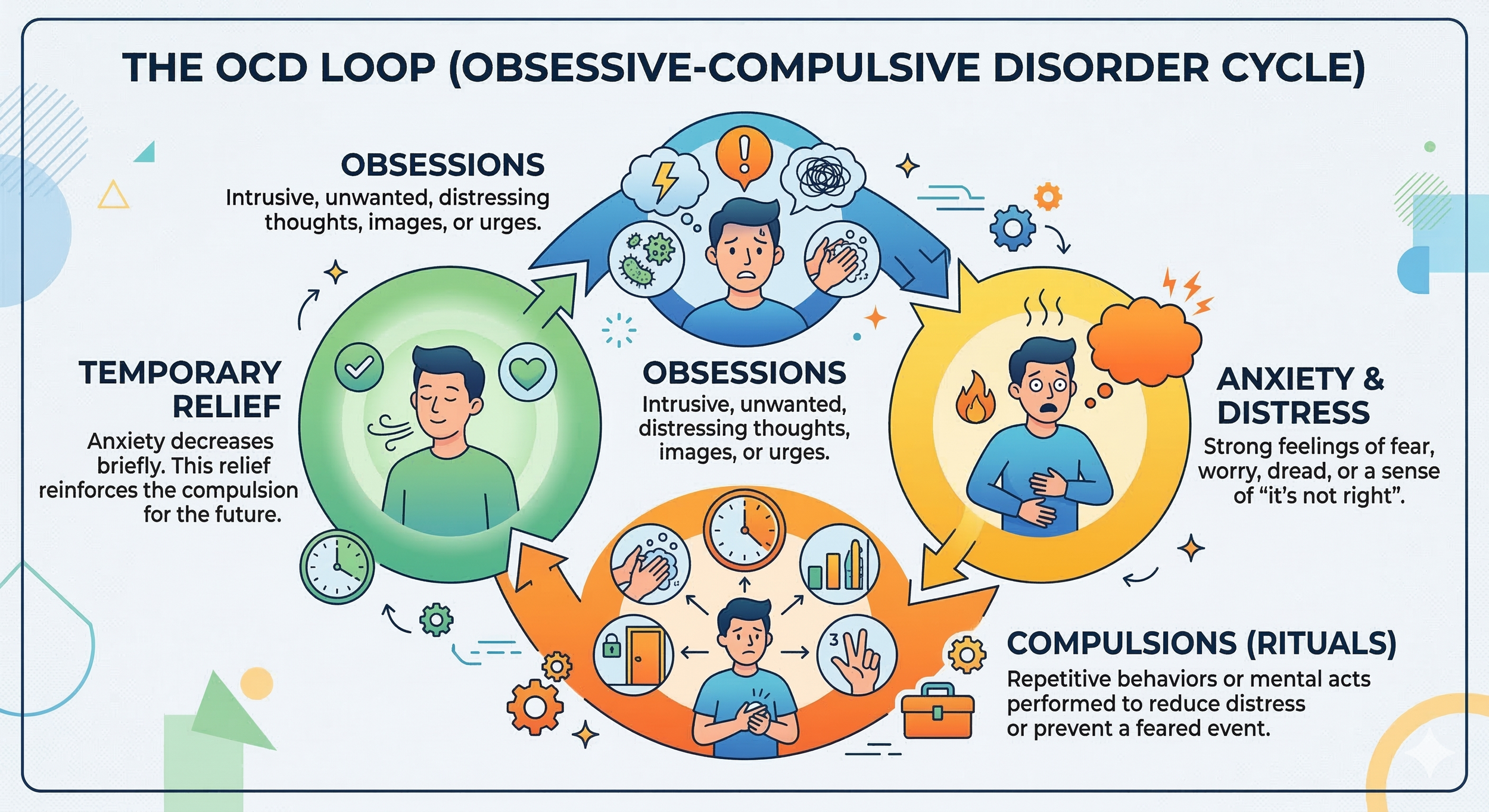
A thought shows up.
Your anxiety spikes.
Your brain tells you that you need to figure it out, prevent something bad from happening, or get reassurance before you can move on.
Maybe you find yourself:
Asking others for reassurance again and again
Avoiding situations that feel unsafe
Mentally reviewing conversations, memories, or decisions
Trying to “cancel out” intrusive thoughts
Checking until something finally feels right
These strategies make sense. They are your brain’s attempt to protect you.
The problem is that OCD learns from what you do next. Every time you respond to anxiety with a compulsion, your brain gets the message:
"This thought must have been important. I needed to do something to feel safe."
Over time, the cycle becomes stronger.
Exposure and Response Prevention (ERP) therapy helps your brain learn a different message:
"I can experience uncertainty. I can feel anxiety. I can have an intrusive thought—and I do not have to respond to it."
At Red Elm Psychotherapy, we specialize in ERP therapy for OCD, intrusive thoughts, and perinatal OCD, serving clients across Virginia and through PSYPACT telehealth.
What Is ERP Therapy for OCD?
Exposure and Response Prevention (ERP) is a specialized form of cognitive behavioral therapy designed specifically to treat OCD.
The name can sound intimidating. Many people hear “exposure” and imagine being forced to face their biggest fear immediately.
That is not what good ERP looks like.
ERP is a collaborative process where you and your therapist identify the patterns that keep OCD going and gradually practice responding differently.
The goal is not to eliminate anxiety forever.
The goal is to stop letting anxiety and OCD make your decisions for you.
ERP involves two parts:
Exposure: Gently and intentionally approaching thoughts, situations, sensations, or uncertainties that OCD tells you to avoid.
Response Prevention: Practicing not engaging in compulsions that temporarily reduce anxiety but keep OCD stuck over time.
What Happens in ERP Therapy?
Understanding Your OCD Cycle
Before starting ERP, your therapist will help you understand how OCD is keeping you stuck.
Together, you’ll look at the thoughts or fears that trigger anxiety and the things you do afterward to try to feel safe or certain.
For many people, those responses are not obvious. They may look like checking, asking for reassurance, avoiding situations, or spending hours trying to analyze a thought until it finally feels resolved.
The problem is that OCD keeps moving the finish line. No amount of checking, analyzing, or reassurance can create the complete certainty OCD is demanding.
ERP helps you begin stepping out of that cycle.Creating a Personalized Exposure Plan
ERP does not mean walking into your biggest fear on the first day of therapy.
Instead, you and your therapist create a gradual plan for practicing uncertainty. This might include approaching situations you have been avoiding, allowing uncomfortable thoughts to be present, or practicing not engaging in the rituals that OCD demands.
The objective is to help you discover that you can experience discomfort and still safely move forward
Learning to Respond Differently
This is the heart of ERP.
When OCD shows up, it often creates a sense of urgency:
"You need to figure this out right now."
"You need to make sure."
"You cannot move on until you feel certain."
ERP helps you practice a different response.
Instead of:
"How do I make this anxiety go away?"
you learn:
"Can I allow this feeling to be here while continuing with my life?"
This might mean resisting the urge to check, avoiding reassurance seeking, or allowing an intrusive thought to exist without trying to analyze what it means.
Over time, your brain learns that anxiety is uncomfortable—but it is not an emergency.
What Changes With ERP?
Over time, many people notice that OCD begins to take up less space.
You may find yourself:
Spending less time analyzing and seeking reassurance
Feeling less controlled by intrusive thoughts
Making decisions based on your values instead of fear
Anxiety and fear can come up, but they no longer make the rules.
ERP Therapy for Perinatal OCD: When Intrusive Thoughts Feel Terrifying
Perinatal OCD can show up as frightening intrusive thoughts, intense guilt, repeated reassurance seeking, or avoiding situations that feel risky. Many mothers find themselves caught in a cycle of trying to prove they are safe, responsible, and "good enough"-but the search for certainty never quite ends.
A Perinatal OCD Example
Many mothers with perinatal OCD describe an experience like this:
After the birth of her baby, a mother begins experiencing intrusive thoughts about something terrible happening. The thoughts feel vivid, unwanted, and deeply upsetting.
She starts wondering:
"What if this thought means something? What if I can't trust myself?"
She begins avoiding situations that trigger anxiety, asking her partner for reassurance, and mentally reviewing moments to figure out whether she missed something.
What makes ERP feel so difficult is not just the anxiety.
It is the feeling that not responding to the thoughts would be irresponsible.
"If there is even a small chance something could happen, shouldn't I do everything I can to prevent it?"
This fear is one reason perinatal OCD can feel so convincing.
Mothers are often surrounded by messages that they should anticipate every possible danger, prevent every mistake, and always know the right thing to do. OCD can take that understandable desire to protect and turn it into an impossible demand for certainty.
In ERP, the goal is not to prove that nothing bad could ever happen.
Instead, therapy focuses on learning that intrusive thoughts are not warnings or commands.
For example, an exposure might involve allowing an intrusive thought to be present during a normal parenting activity while practicing not engaging in compulsions that keep OCD going—such as reassurance seeking, mental reviewing, or avoidance.
The goal is not to become careless.
The goal is to learn that you can be a caring, responsible mother without needing absolute certainty before you trust yourself.
Over time, many mothers find that the thoughts become less urgent, and they are able to spend more time being present with their babies instead of constantly trying to prevent imagined dangers.
This is a fictional example created to illustrate how perinatal OCD can show up and how ERP therapy works.
ERP Therapy in Virginia and Through PSYPACT Telehealth
Finding specialized OCD treatment can be challenging. Many therapists are trained in general anxiety treatment but do not have specific training in ERP.
At Red Elm Psychotherapy, we provide:
OCD therapy in Vienna, VA
ERP therapy for OCD in Northern Virginia
Virtual ERP therapy across participating PSYPACT states
Specialized treatment for perinatal OCD and intrusive thoughts
You do not have to spend years trying to outthink OCD.
Start ERP Therapy for OCD in Virginia
If you are struggling with OCD, intrusive thoughts, or perinatal OCD, therapy can help you break free from the cycle of fear and compulsions.
Starting ERP can feel intimidating—but you do not have to feel completely ready before reaching out.
Many people begin therapy feeling unsure, scared, or convinced their thoughts are different from everyone else’s.
You are not the first person to bring these fears into therapy.
At Red Elm Psychotherapy, we provide compassionate, specialized ERP therapy for OCD across Virginia and through PSYPACT telehealth.
Schedule a consultation to learn how ERP therapy can help you move toward a life that is guided by your values—not by OCD.
How to Find an OCD Specialist in Northern Virginia (And Why Specialization Matters)
Not all therapy approaches treat OCD effectively. Learn why Exposure and Response Prevention (ER) is considered the gold- standard treatment, how to find an OCD specialist in Northern Virginia, and what questions to ask when choosing a therapost. We also discuss why specialized care is especially important during pregnancy and postpartum.
If you’ve been in therapy before and still feel like OCD is running your life, you’re not alone.
Many people with OCD spend months—or even years—in therapy before receiving treatment that actually targets OCD. They may leave sessions feeling understood and supported, yet still find themselves trapped in the same exhausting cycle of intrusive thoughts, compulsions, reassurance-seeking, and self-doubt.
That doesn’t mean therapy can’t help.
It usually means you haven’t been given the right treatment for OCD.
At Red Elm Psychotherapy, we specialize in treating OCD using Exposure and Response Prevention (ERP), the gold-standard treatment for OCD. We often meet clients across Northern Virginia who tell us, “I’ve been in therapy for years, but no one ever explained OCD this way.”
Why General Therapy Isn’t Always Enough for OCD
Standard therapy tools are incredibly valuable.
Supportive therapy can help people navigate grief, relationship challenges, work stress, trauma, depression, and major life transitions. Many compassionate therapists provide exceptional care using these approaches.
But OCD works differently.
Imagine breaking your arm. Your primary care physician is highly trained and incredibly knowledgeable—but they’re still likely to refer you to an orthopedic surgeon. Not because your primary care doctor isn’t good at their job, but because certain conditions require specialized expertise.
OCD is much the same.
OCD is driven by a cycle of intrusive thoughts, anxiety, compulsions, and temporary relief. Because of how this cycle works, some therapy strategies that are helpful for other concerns can unintentionally strengthen OCD.
For example, spending time analyzing why you had a particular thought, searching for certainty, or repeatedly offering reassurance can actually reinforce OCD’s message that the thought is dangerous and must be solved.
It’s not that those therapy approaches are “wrong.”
It’s that OCD requires a different blueprint.
Why Exposure and Response Prevention (ERP) Works
ERP is considered the gold-standard treatment for OCD because it targets the cycle that keeps OCD alive.
Rather than trying to convince you that your intrusive thoughts aren’t true, ERP teaches your brain something much more powerful:
You can experience uncertainty, anxiety, or intrusive thoughts—and choose not to respond with compulsions.
That might mean resisting mental checking, avoiding reassurance, postponing Google searches, stopping confession rituals, or gradually approaching situations OCD has taught you to fear.
Over time, your brain begins to learn that anxiety naturally rises and falls without needing compulsions to make it disappear.
This process helps retrain your brain’s alarm system. Instead of learning, “I survived because I checked,” your brain begins learning, “I survived because I didn’t need to check.”
Research consistently shows that ERP changes the way the brain responds to intrusive thoughts in a way that simply talking about the anxiety cannot.
Effective ERP Should Be Evidence-Based and Human
Many people come to us after trying ERP elsewhere with mixed experiences.
Some describe treatment that felt incredibly rigid—sessions focused almost exclusively on anxiety ratings, or feeling as though every question was met with silence out of fear that any response might become reassurance. Others leave believing ERP means being pushed into overwhelming exposures before they feel understood.
That isn’t how we practice.
At Red Elm Psychotherapy, ERP is the foundation of our OCD treatment because it’s the most effective, evidence-based approach we have. But we also believe that healing happens within a strong therapeutic relationship.
That means we take time to understand your story, teach you how OCD works, and collaborate on exposures that are challenging without being overwhelming. We integrate cognitive behavioral strategies and an attachment-informed understanding of relationships while keeping ERP at the center of treatment.
Our goal isn’t to withhold warmth or become emotionally distant. It’s to avoid reinforcing OCD while helping you feel genuinely supported.
You should never have to choose between evidence-based treatment and a therapist who feels human.
What This Looks Like in Real Life
(Note: To protect client confidentiality, the following scenario is a composite case study reflecting common patterns seen in our practice.)
One client came to us after several years of therapy for anxiety. She was thoughtful, self-aware, and had done a lot of work to understand her thoughts. On the surface, it seemed like she “should” have been feeling better by that point.
But her OCD hadn’t changed.
She was still spending hours each day mentally reviewing conversations, trying to determine whether she had said or done something “wrong.” She sought reassurance from loved ones, experienced brief relief, and then quickly found herself back in doubt. Much of her prior therapy had focused on understanding why she felt anxious and processing the distress, which helped her feel supported—but didn’t change the underlying cycle.
When we began ERP, the focus shifted. Instead of trying to solve or analyze the thoughts, she practiced allowing them to be present without engaging in the mental review or reassurance-seeking that followed.
At first, this felt unfamiliar and uncomfortable. Her OCD consistently pushed her toward “figuring it out” the way she always had.
But over time, something important changed: the thoughts didn’t disappear, but they also didn’t pull her into hours of rumination. The urgency softened. The cycle began to lose momentum.
What she described later wasn’t a life without intrusive thoughts—it was a life where she no longer felt trapped in them.
That shift is often what recovery from OCD looks like.
Why Specialized OCD Care Matters Even More During Pregnancy and Postpartum
While finding an OCD specialist is important for anyone with OCD, it becomes especially important during pregnancy and the postpartum period.
Perinatal OCD often involves intrusive thoughts about accidentally or intentionally harming the baby. These thoughts can feel terrifying, especially when they seem completely out of character.
One of the biggest fears we hear from new mothers is: “What if someone thinks these thoughts mean I want to hurt my baby?”
The good news is that intrusive thoughts are actually incredibly common during the perinatal period. For someone with OCD, these thoughts are ego-dystonic—meaning they are unwanted, deeply distressing, and completely inconsistent with who you are as a parent.
Unfortunately, providers without specialized training in perinatal OCD may mistake these symptoms for postpartum anxiety alone, respond with repeated reassurance, or, in rare cases, misunderstand them as postpartum psychosis.
These are very different conditions requiring different treatment approaches.
An OCD specialist understands these differences and knows that ERP can safely and effectively treat perinatal OCD while supporting the unique realities of pregnancy and early parenthood.
The goal isn’t to convince you that you’ll never have another intrusive thought.
The goal is to help those thoughts lose their power, so you can spend more time connecting with your baby and less time trapped in fear.
Questions to Ask When Looking for an OCD Therapist in Northern Virginia
Not every therapist specializes in OCD—and that’s okay. Just like in medicine, different clinicians develop expertise in different areas.
If you’re looking for OCD treatment in Northern Virginia (including Vienna, Mclean, Fairfax, Arlington, or Loudoun County), consider asking potential providers:
What percentage of your practice is dedicated to treating OCD?
Have you received specialized training in Exposure and Response Prevention (ERP)?
What does a typical ERP session look like?
How do you respond when clients seek reassurance during sessions?
Do you regularly treat the specific type of OCD I’m experiencing, such as postpartum OCD, scrupulosity, health OCD, or relationship OCD?
These questions can help you determine whether a therapist has the experience needed to provide evidence-based OCD treatment.
You Don’t Have to Stay Stuck
Living with OCD can be exhausting, but it is also highly treatable.
If you’ve tried therapy before without lasting relief, that doesn’t mean you’ve failed therapy. It may simply mean you haven’t yet received treatment specifically designed for OCD.
At Red Elm Psychotherapy, we provide evidence-based ERP for adults through in-person therapy at our Vienna, VA office and via telehealth throughout the state of Virginia. We also specialize in treating perinatal OCD, helping parents navigate pregnancy and postpartum with compassionate, expert care.
Recovery doesn’t require getting rid of every intrusive thought. It comes from learning that you no longer have to listen to them.
Ready to Take the Next Step?
If you're ready to break the OCD cycle, we are here to walk with you. Click here to schedule a free 15-minute consultation with us today.

It’s Not Control, It’s Postpartum Anxiety: Maternal Gatekeeping, Intrusive Thoughts, and OCD
Up until now, you and your partner have felt like a team. But suddenly, you don't trust him to change a diaper or put the baby to sleep—not because he lacks skills, but because your nervous system is treating uncertainty like danger. Here is what is actually happening behind the nursery door, and how to break the anxiety cycle together.
Written collaboratively by Dr. Erin Cook, PsyD, PMH-C and Dr. Niles Cook, PsyD
You knew having a baby would be exhausting. You were told by friends and family that “it’s hard,” but you probably didn't anticipate the intense fear associated with being responsible for keeping another human alive every second of every day.
Up until now, you and your partner have felt just like that—partners. Suddenly, you don’t trust your husband to change a diaper, feed the baby, or put them to sleep. When you try to let him help, you start to wonder:
“What if he doesn't notice she's too hot?”
“What if he buckles the car seat wrong?”
“What if he relaxes for five minutes and something terrible happens?”
Over time, these thoughts start dictating the rules of the household. Your fear decides who can hold the baby, how things should be done, and what counts as "safe enough."
You can know, logically, that nothing is actually wrong—and still feel your body react as if something is. You can tell yourself your partner is capable, that the baby is safe, that this minor detail probably doesn’t matter… and still feel an urgent pull to step in and fix it. Not because you want control, but because your nervous system is treating uncertainty like danger. And underneath all of it is often something very simple: profound exhaustion, and the longing to not have to carry the weight of this family all alone.
From the outside, this can look like “new mom protectiveness” or a mother's intuition. You may even get praised for “being so natural.” But inside the home, it becomes a behavioral expression of maternal gatekeeping—a common dynamic in postpartum anxiety and postpartum OCD. In order to quiet the alarms in your mind, you may begin hovering during diaper changes, correcting a partner's every move, redoing tasks that were already completed, or struggling to hand the baby over at all.
It’s isolating to feel like you are the only one capable of caring for your baby, and it’s equally isolating to feel like your partner doesn’t trust you to care for your own child. But what many couples miss is that this dynamic is rarely about competence, trust, or a lack of relationship skills. More often, it's an anxiety cycle. And the more everyone tries to help by organizing their lives around that anxiety, the more power it gains, silently reshaping the patterns of your home.
Driven by Anxiety, Not Control
If you are the parent who can't let go, this isn't a power trip. It’s a heavy, invisible burden. To you, hyper-vigilance doesn't feel like control—it feels like the only baseline option for keeping your baby alive. Your brain gets stuck in a constant, protective loop:
“If I don't pay attention, something bad could happen.”
“If I hand the baby over and something goes wrong, I'll never forgive myself.”
“I should be able to relax, but what kind of mother relaxes when her baby needs her?”
The maternal brain is naturally wired to be protective. After birth, hormonal shifts, chronic sleep deprivation, and the sudden weight of caring for a vulnerable infant naturally heighten your awareness of danger. But when postpartum anxiety or OCD enters the picture, that protective instinct goes into overdrive.
Ordinary uncertainty starts feeling intolerable.
Normal parenting risks begin to feel like emergencies.
For some parents, the problem is relentless worry. For others, it's a stream of unwanted intrusive thoughts that feel impossible to ignore.
These intrusive thoughts—which are common and often harmless—start feeling like urgent warnings that must be acted upon. They can be incredibly vivid and alarming, but it is important to know they are a reflection of how deeply you care, not what you actually want, intend, or believe.
Instead of recognizing these thoughts as anxiety, your brain begins treating these internal alarms as real, immediate danger. This traps you in an exhausting cycle: If I stay alert enough, careful enough, and in control enough, I can prevent catastrophe.
For a brief moment, managing the environment reduces the panic.
Watching the diaper change.
Checking the monitor again.
Correcting the swaddle.
Standing in the doorway while your partner puts the baby to sleep.
But the relief is always temporary. The anxiety quickly returns with a new scenario, a new doubt, or a new reason to stay vigilant. Many mothers secretly wonder whether they are becoming the kind of parent they never wanted to be—controlling, irritable, and unable to relax—without realizing that a biological anxiety loop is quietly driving the entire process.
Over time, this burden becomes unsustainable. Many mothers describe feeling trapped in the role of the "only safe parent." They desperately need a break but cannot convince their nervous system to take one. They feel drained and isolated, carrying a level of responsibility that no single person was ever meant to carry alone.
If this sounds familiar, you're not failing at motherhood. You're caught in an anxiety cycle that has gradually convinced you that control equals safety. And that cycle can be treated.
Related Reading: Why do intrusive thoughts feel so real after having a baby?
Related Service: Perinatal OCD Therapy
Walking on Eggshells in the Nursery
While moms are carrying immense fear, many husbands are carrying a different kind of pain—the feeling of being shut out of the parenting relationship entirely.
Having a baby completely changes the natural dynamic of a relationship. Where you used to navigate life as a cohesive team focused on each other, suddenly you can feel secondary to the demands of the nursery. Time that used to be spent connecting is now entirely consumed by infant care. If your partner is breastfeeding, it can feel like she has a biological monopoly on comforting the baby, leaving you to feel like an observer during the few hours the baby is awake and content. And yet, when you try to step in and help in the small ways you can find, your wife shuts you down, leaving you feeling entirely unnecessary.
At first, many partners try harder. They ask questions, double-check instructions, and try to memorize shifting schedules. They genuinely want to help. But when every diaper change is corrected, every bottle is inspected, and every parenting decision is second-guessed, a painful story begins to form:
“Maybe I'm just bad at this.”
“She clearly doesn't trust me.”
“Why bother trying if she's just going to redo it anyway?”
Many husbands describe feeling like a guest in their own home—or worse, a helper waiting for instructions from the "real parent." They love their baby, they love their partner, yet they increasingly feel disconnected from both.
Because they care and can see how exhausted their spouse is, partners start accommodating the anxiety to keep the peace. They hand the baby back immediately when asked. They stop offering help. They avoid taking initiative. They offer endless reassurance and quietly step aside.
In the short term, this reduces household tension. In the long term, it anchors the anxiety cycle. Each time a partner withdraws, the mother’s anxious brain receives the same false confirmation: "See? You really are the only person who can do this safely."
The anxiety cycle gains more authority, while the partner becomes less confident, less involved, and more distant. Eventually, couples find themselves stuck in a painful pattern: one parent feels abandoned and overwhelmed, the other feels rejected and unnecessary. What started as an attempt to protect the baby slowly begins to erode the partnership itself. And neither partner knows how to stop it without making things worse.
This is one of the reasons postpartum anxiety and postpartum OCD are never just individual problems. They naturally become relationship challenges, not because anyone has done something wrong, but because anxiety has quietly inserted itself between two people who are trying their best. And unless the cycle is addressed directly, the distance tends to grow.
Breaking the Cycle: How to Reclaim Your Partnership Together
Realizing that an anxiety cycle has taken root in your home can be an enormous relief. It means Mom isn't trying to be controlling, and Dad isn't necessarily disengaged or incompetent. Both partners have simply been responding to an anxiety loop that quietly inserted itself into the family system.
But insight alone isn't enough. To reclaim your partnership, both parents need to stop organizing their daily lives around the anxiety's demands.
In Exposure and Response Prevention (ERP), we look at how to break the cycle of obsession, anxiety, and accommodation. In systemic therapy, we look at how each person's understandable responses can unintentionally keep a problem alive. The goal isn't to make anxiety disappear overnight; the goal is to stop letting it make your parenting decisions. Here is how you can start disrupting the loop as a team:
Step 1: Externalize the Anxiety
One of the most powerful shifts a couple can make is learning to identify the real adversary. Without this step, it's easy to get stuck in painful, defensive stories about each other: "She doesn't trust me," or "He doesn't understand how serious this is."
Instead, try naming the anxiety directly. Call it Postpartum Anxiety, Postpartum OCD, or "the anxiety loop." The specific name matters less than recognizing that something separate from either partner is influencing the family. Try shifting your language to reflect this:
“I know you know how to feed the baby. My anxiety is just really loud right now.”
“I can feel the OCD trying to convince me that I need to check the car seat again.”
“This feels like an anxiety problem, not a marriage problem.”
When couples begin speaking this way, the conversation instantly becomes less defensive and more collaborative. Instead of fighting each other, you begin working together against the anxiety.
Step 2: The Controlled Hand-Off (For Mom)
One of anxiety's favorite lies is: "If you don't stay involved, something bad will happen.” This is where ERP helps—by allowing you to discover that this isn't true through real-world experience and curated exposures with your therapist.
ERP helps you learn to gradually face uncertainty without performing the safety behaviors (compulsions) that keep you stuck. In the nursery, this means practicing intentional hand-offs:
Allow your partner to put the baby down for a nap while you completely leave the room or the house.
Intentionally resist the urge to watch the baby monitor continuously.
Notice that a swaddle isn't exactly how you would do it—and consciously choose not to fix it.
One of the hardest lessons in early parenthood is learning that different does not automatically mean dangerous. Your partner may do things differently than you would, and allowing space for those differences is a powerful, necessary exposure in its own right.
At first, your anxiety will spike. Your brain may produce endless reasons why you need to step back in. The work is not convincing yourself everything will be perfectly okay; the work is allowing uncertainty to exist without rushing to eliminate it. Over time, your nervous system learns that discomfort is not the same thing as danger, and you gather real evidence that your partner is fully capable.
The goal isn't becoming a perfectly relaxed parent. The goal is becoming a parent who no longer lets anxiety be in charge.
Step 3: Holding the Line with Compassion (For the Husband)
Supporting recovery requires deep compassion paired with firm boundaries. Giving repeated reassurance or quietly stepping aside reduces distress in the short term, but it accidentally teaches the anxiety loop that it deserves special authority in your home.
Instead of accommodating, try holding the line kindly but firmly:
“I know this is really hard right now and your anxiety is loud. But I have the baby, the baby is safe, and I need you to go take a break while I handle this.”
“I love you, and because I love you, I'm not going to answer that reassurance question again.”
This approach isn't about being dismissive; rather, it is about actively engaging and refusing to let anxiety dictate the family's rules. As partners stop accommodating, they rebuild confidence in their own parenting abilities while mothers begin learning that they don't have to carry the impossible burden of being the only safe parent. Recovery happens when both people stop feeding the cycle.
Reclaiming Your Partnership
Postpartum anxiety and postpartum OCD thrive on isolation. They convince one parent that vigilance is love, and the other parent that stepping back is helpful. They turn teammates into adversaries, and they quietly steal joy from a season of life that is already demanding enough.
The good news is that these patterns are highly treatable. When couples learn to recognize anxiety for what it is, stop accommodating its demands, and practice tolerating uncertainty together, the anxiety cycle gradually loses its influence.
The goal isn't perfect parenting. The goal is shared parenting. A nursery where both parents feel competent. A home where anxiety no longer gets the final vote. A partnership where neither parent has to carry the impossible burden alone.
Need Support Navigating Postpartum Together?
If this pattern feels familiar in your home—where love, fear, and exhaustion are getting tangled in how you parent—you don’t have to figure it out alone. At Red Elm Psychotherapy, we understand both sides of this equation.
We understand how quickly a season that was supposed to feel joyful can become consumed by fear, second-guessing, and the exhausting belief that you have to carry everything yourself. We also understand the frustration and helplessness that partners experience when they don’t know how to help.
Together, we can help you break the cycle, build your confidence, and reclaim your partnership.Reach out to Red Elm Psychotherapy today to schedule an intake.
About the Authors
Dr. Erin Cook, PsyD, PMH-C is a licensed psychologist and Certified Perinatal Mental Health specialist at Red Elm Psychotherapy. Grounded in evidence-based care, her clinical practice includes helping individuals navigate anxiety, OCD, and complex transitions across the entire reproductive journey—from preconception and fertility challenges through pregnancy and the postpartum period.
Dr. Niles Cook, PsyD is a clinical psychologist and expert in OCD and anxiety disorders, with advanced training in Exposure and Response Prevention (ERP). At Red Elm Psychotherapy, he helps patients across Virginia understand their OCD cycle, reduce compulsions, and build a more flexible relationship with fear, doubt, and uncertainty.

Trying to Conceive Without Losing Yourself: Understanding Fertility Anxiety and OCD
For many women, the emotional journey into parenthood begins long before a positive pregnancy test. When the path to pregnancy becomes consumed by an exhausting cycle of anxiety, hyper-tracking, and a search for certainty, you aren't just stressed—your mind may be caught in an OCD loop. Learn how to carry hope without losing yourself in the process.
For many women, becoming pregnant isn't as straightforward as they imagined.
After years of preventing pregnancy, it can be startling to discover how much uncertainty is involved in trying to conceive (TTC). What many expected to be a simple next step can instead become months or years of planning, medical appointments, fertility treatments, disappointments, and difficult waiting.
For some women, the emotional journey into parenthood begins long before a positive pregnancy test.
Feeling anxious during this process is completely understandable. When something matters deeply, uncertainty naturally feels difficult. But sometimes anxiety becomes more than worry. Thoughts become "sticky." Reassurance never seems to last. Tracking starts to consume more and more time.
For some individuals, the struggle is not just fertility-related stress. It is anxiety or OCD attaching itself to fertility and reproduction.
When Anxiety Becomes a Full-Time Job
Many women experiencing fertility-focused anxiety appear thoughtful, informed, and responsible from the outside. They know the details of their cycle. They have researched treatment options. They are paying close attention to their health.
But internally, they may feel trapped in a cycle of fear and vigilance, constantly wondering:
What if my body is broken?
What if I waited too long?
What if something I did years ago affected my fertility?
What if I missed my fertile window?
What if this symptom means something important?
What if I never become a parent?
These thoughts often feel urgent, important, and impossible to ignore.
The OCD Cycle and Fertility
OCD thrives wherever certainty is impossible—and fertility is full of uncertainty.
Even with excellent medical care, perfect timing, and healthy reproductive systems, no one can guarantee a specific outcome. For someone vulnerable to OCD, that uncertainty can feel unbearable.
When applied to the reproductive journey, the OCD cycle typically looks like this:
1. The Obsession: An intrusive thought or image appears suddenly.
“What if I accidentally ruined my chances of getting pregnant this month?”
2. The Compulsion: To feel more certain, safe, or in control, you engage in a physical or mental behavior. You search online for hours, compare your experience to others on forums, analyze physical symptoms repeatedly, check fertility tracking apps over and over, or mentally review past decisions.
3. Temporary Relief: Your anxiety decreases briefly because you found a "reassuring" piece of data.
4. The Return of Doubt: A new "what-if" appears. “But what if that information was wrong? What if I misread the test?” And the loop starts all over again.
Unfortunately, every attempt to eliminate uncertainty accidentally teaches the brain that uncertainty is dangerous and must be solved immediately.
What Fertility OCD Can Look Like
Because fertility tracking is often medically recommended, it can be incredibly difficult to recognize when helpful monitoring has shifted into compulsive, anxiety-driven monitoring.
Hyper-Tracking
Tracking becomes difficult to stop even when it no longer feels useful. You may find yourself checking multiple apps, taking repeated ovulation tests long after your peak, recording every minor bodily sensation, and constantly comparing current and past cycles.
Somatic Hyperawareness
Your attention becomes glued to your body. Every cramp, twinge, headache, or wave of nausea feels potentially significant. You may spend large portions of the day trying to determine what these symptoms "mean" during the grueling two-week wait.
Reassurance Seeking
You repeatedly look for certainty from partners, friends, healthcare providers, online communities, fertility forums, and search engines. The reassurance helps briefly, but the relief never seems to last.
Mental Reviewing
You replay events repeatedly in your head: Did I time intercourse correctly? Did I eat something harmful? Did I exercise too much? Did I miss an important sign? Instead of creating clarity, this mental reviewing only creates more doubt.
Why "Just Relax" Doesn't Help
Women trying to conceive are frequently given well-intentioned but deeply frustrating advice: "Just stop thinking about it," "Relax and it will happen," or "Stress is probably making it harder."
While usually meant to be comforting, these comments can leave people feeling blamed and isolated. For someone struggling with anxiety or OCD, "just relax" simply creates another impossible task. Now there is a new fear: “What if my anxiety is the reason I’m not pregnant?”
The result is a cruel loop of anxiety about anxiety. No one can simply decide not to care about something deeply meaningful.
Fertility Challenges and Real Losses
It's also vital to acknowledge that fertility anxiety does not occur in a vacuum. Many women navigating these challenges have also experienced:
Failed fertility treatments (failed IUI or IVF cycles)
Reproductive trauma
In these situations, fears are not coming from nowhere. The goal of therapy is not to convince you that everything will be fine. The goal is to help you carry uncertainty, grief, fear, and hope without becoming trapped in endless, exhausting attempts to control what cannot be fully controlled.
Fertility OCD, Pregnancy OCD, and Postpartum OCD
One reason fertility OCD often goes unrecognized is that many people assume the symptoms will automatically disappear once pregnancy occurs. Sometimes they do—but often, the underlying themes simply shift.
The fear easily moves from "What if I can't get pregnant?" to "What if I harm this pregnancy?" and later, topostpartum intrusive thoughtslike "What if I harm my baby?"
This is one reason specialized perinatal and postpartum mental health care can be so valuable. Understanding OCD across the reproductive journey allows treatment to address the underlying psychological process rather than only chasing the current, shifting fear.
Reclaiming Your Life While Trying to Conceive
The goal of therapy is not to stop caring about becoming pregnant. The goal is to stop allowing anxiety and OCD to take over your life while you wait.
With specialized, evidence-based treatment, many women learn how to:
Reduce compulsive tracking and checking behaviors
Respond differently to intrusive, sticky thoughts
Tolerate uncertainty without endless reassurance seeking
Stay anchored and present during the two-week wait
Separate their inherent worth from reproductive outcomes
Continue building a meaningful, vibrant life while pursuing parenthood
Trying to conceive is already hard enough. You shouldn't have to spend the process battling your own mind every day. If fertility anxiety or OCD has begun to consume your thoughts, relationships, or daily functioning, support is available. You do not have to navigate the uncertainty of this journey alone.
Not sure whether it's anxiety, OCD, or something else?
Many women assume their fertility worries are "just part of trying to conceive." A consultation with a therapist trained in perinatal mental health can help you better understand what you're experiencing and what treatment approach may be most helpful.
Reach out to schedule a consultation today.
Looking for professional support on your journey? Learn more about our specialized Fertility Therapy Services.
About the Author:
Dr. Erin Cook, PsyD, PMH-C is a licensed psychologist and Certified Perinatal Mental Health specialist at Red Elm Psychotherapy. Grounded in evidence-based care, her clinical practice includes helping individuals navigate anxiety, OCD, and complex transitions across the entire reproductive journey—from preconception and fertility challenges through pregnancy and the postpartum period.

The Birth Story Loop: When “Healthy Baby, Healthy Mom” Isn't Enough
Birth trauma isn't just about what happened in the delivery room—it’s about the mental 'loops' that follow. Dr. Erin Cook explores the intersection of birth trauma and OCD, explaining how a 'clinical emergency' can trigger chronic rumination. Learn how Narrative Therapy and ERP provide a gold-standard path to recovery for postpartum parents.
Sarah had always been a planner. From her college applications to her wedding seating chart, her life was a series of well-executed visions. When she got pregnant, she approached motherhood with that same intentionality. She spent months curating the perfect nursery, researching breast pumps, and eventually, crafting a birth plan that felt like a sanctuary.
She imagined the dim lighting, the specific playlist, and the freedom to move. She was even "rational" about the possibility of a C-section: “As long as we’re both happy and healthy, who cares how the baby comes?” she’d tell herself.
But when Sarah went into labor at 35 weeks, the plan didn't just change—it evaporated.
Suddenly, she wasn't in a dimly lit room with a birth ball; she was hooked to monitors in a sterile high-risk unit. Her blood pressure soared. She was placed on a magnesium drip—a medication that felt like a heavy, searing fog settled over her brain. Her regular doctor was out of town, and the on-call physician seemed to view her birth plan as a list of suggestions rather than her deeply held values.
In that room, the medical team saw a “clinical emergency” to be managed, but Sarah felt like a person being erased. She felt like a vessel for a baby rather than a participant in her own life. That loss of voice—that moment where her “No” or her “Wait” was ignored—became the sharpest edge of the experience.
The Birth of the Loop
A week later, Sarah was home. Her daughter was healthy, and the beautiful nursery was finally in use. But Sarah’s mind was still in that hospital room.
Even though the physical "outcome" was a success, Sarah found herself stuck in what we call the Birth Story Loop. Every time she looked at her daughter, her brain would pivot:
“What if I had rested more in those last few weeks?”
“What if I had advocated harder when the doctor mentioned the induction?”
“Did I fail because I didn't push longer?”
Every time a "perfect" birth announcement popped up on her Instagram feed, she felt a physical pang of jealousy, followed immediately by a wave of shame. She felt like a "bad mom" for not being able to celebrate others, not realizing her brain was simply triggered by the contrast between their agency and her trauma.
Why the Brain Loops: The Unfinished Puzzle
For high-achievers like Sarah, the brain treats a traumatic or disappointing birth like an unsolved puzzle. Because of the magnesium fog and the sheer adrenaline of the emergency, Sarah’s brain didn't get to "record" the birth in a linear way.
It’s like a book with five missing pages in the middle. Her brain keeps looping back to those pages, trying to fill in the blanks of what happened while she was "out of it," hoping that "certainty" will finally bring peace.
In reality, this is rumination—a mental compulsion. The more Sarah "checks" her memories or asks for reassurance from her husband ("Do you think the doctor waited too long?"), the more her brain stays in emergency mode. She isn't processing the birth; she’s re-traumatizing herself through the loop.
How We Break the Loop in Therapy
At Red Elm, we help parents break the loop using a two-pillar approach:
1. Narrative Therapy: Reclaiming the Story We work to externalize the "failure." Sarah didn't fail her birth; she navigated a medical event that went off-script. We move from the toxic positivity of "at least everyone is okay" to the emotional truth of "this was scary, and I am allowed to grieve the experience I didn't get." We help you integrate the disappointment so it becomes a part of your history, rather than a shameful secret.
2. ERP: Stopping the Compulsions Exposure and Response Prevention (ERP) is the "gold standard" for the anxiety and OCD that often follows a difficult birth.
The "Response Prevention": We identify the reassurance-seeking (the googling, the constant asking of a partner) and practice sitting with the discomfort of not knowing for sure.
The "Exposure": We might write out the "scariest version" of the birth story and read it together until the "shiver" it sends down your spine begins to habituate.
Beyond “Healthy”
If you find yourself stuck in a birth story loop, know that your disappointment isn't ungratefulness. It is a sign that your brain is trying to make sense of a moment where you lost your agency.
Therapy isn’t about changing what happened in that hospital room. But we can stop the birth from "happening" to you every single day in your head. It’s time to reclaim your energy for the life you’re building now.
Reach out now to stop the birth story loop.
About the Author
Dr. Erin Cook is a clinical psychologist and co-founder of Red Elm Psychotherapy, a Virginia-based practice specializing in perinatal mental health and OCD.
She works with women navigating the complexities of pregnancy, postpartum, and early motherhood—specializing in those moments when anxiety or intrusive thoughts feel overwhelming or out of character. Her approach to treating birth trauma is collaborative, thoughtful, and grounded in helping clients understand the "why" behind their brain’s loops so they can finally feel less alone in their experience.