
Relationship OCD (ROCD) Therapy in Virginia
You love your partner—but something doesn’t feel right.
You find yourself questioning your relationship in ways you can’t seem to stop.
You wonder if your feelings are strong enough.
You replay conversations, looking for signs that something is off.
You compare your relationship to others, trying to figure out if yours measures up.
You check how you feel—again and again—hoping for certainty.
And even when things seem okay for a moment, the doubt comes back.
If this feels familiar, you may be experiencing Relationship OCD (ROCD).
What is Relationship OCD?
Relationship OCD is a form of obsessive-compulsive disorder that centers on doubt and uncertainty about a relationship.
It’s not about whether a relationship is objectively “right” or “wrong.” Instead, it’s about getting stuck in a pattern of needing to feel certain—and not being able to.
People with ROCD often experience intrusive thoughts like:
“What if I don’t really love them?”
“What if this isn’t the right relationship?”
“What if I’m making a mistake?”
These thoughts can feel urgent and important, even when part of you recognizes they may not reflect reality.
In OCD, it’s the pattern—not the content—that matters most.
Relationship OCD is one way OCD can show up. You can learn more about our approach to OCD therapy in Virginia.
The Cycle of Doubt in ROCD
ROCD tends to follow a predictable cycle.
A thought or feeling shows up—often suddenly.
It creates anxiety or discomfort.
You try to resolve it by thinking it through, checking your feelings, or seeking reassurance.
You feel temporary relief.
And then the doubt returns.
Over time, this cycle can become exhausting.
The more you try to figure it out, the more unclear things can start to feel.
This pattern is part of a broader OCD cycle. You can read more about how that works in our post on the OCD cycle.
One of the hardest parts of ROCD is how real it feels.
Relationships naturally involve uncertainty. Feelings shift. Doubt comes and goes. No one feels completely sure all the time.
But ROCD treats that normal uncertainty as something that needs to be solved.
Why ROCD Feels So Convincing
The mind starts asking:
“What does this feeling mean?”
“Why don’t I feel the way I think I should?”
“What if this doubt is trying to tell me something important?”
The more you analyze, the more attention you give the doubt—and the stronger it becomes.
The problem isn’t that you’re not thinking clearly.
It’s that you’re trying to think your way out of something that isn’t solved by thinking.
What You Might Be Doing to Cope
If you’re dealing with ROCD, you may find yourself:
Replaying conversations or interactions
Checking your feelings toward your partner
Comparing your relationship to others
Taking quizzes or searching online for answers
Asking friends or your partner for reassurance
These strategies make sense. They’re attempts to feel more certain and more at ease.
But over time, they tend to keep the cycle going.
For some people, these patterns become especially intense during major life transitions, including pregnancy or postpartum. You can learn more about perinatal OCD here.
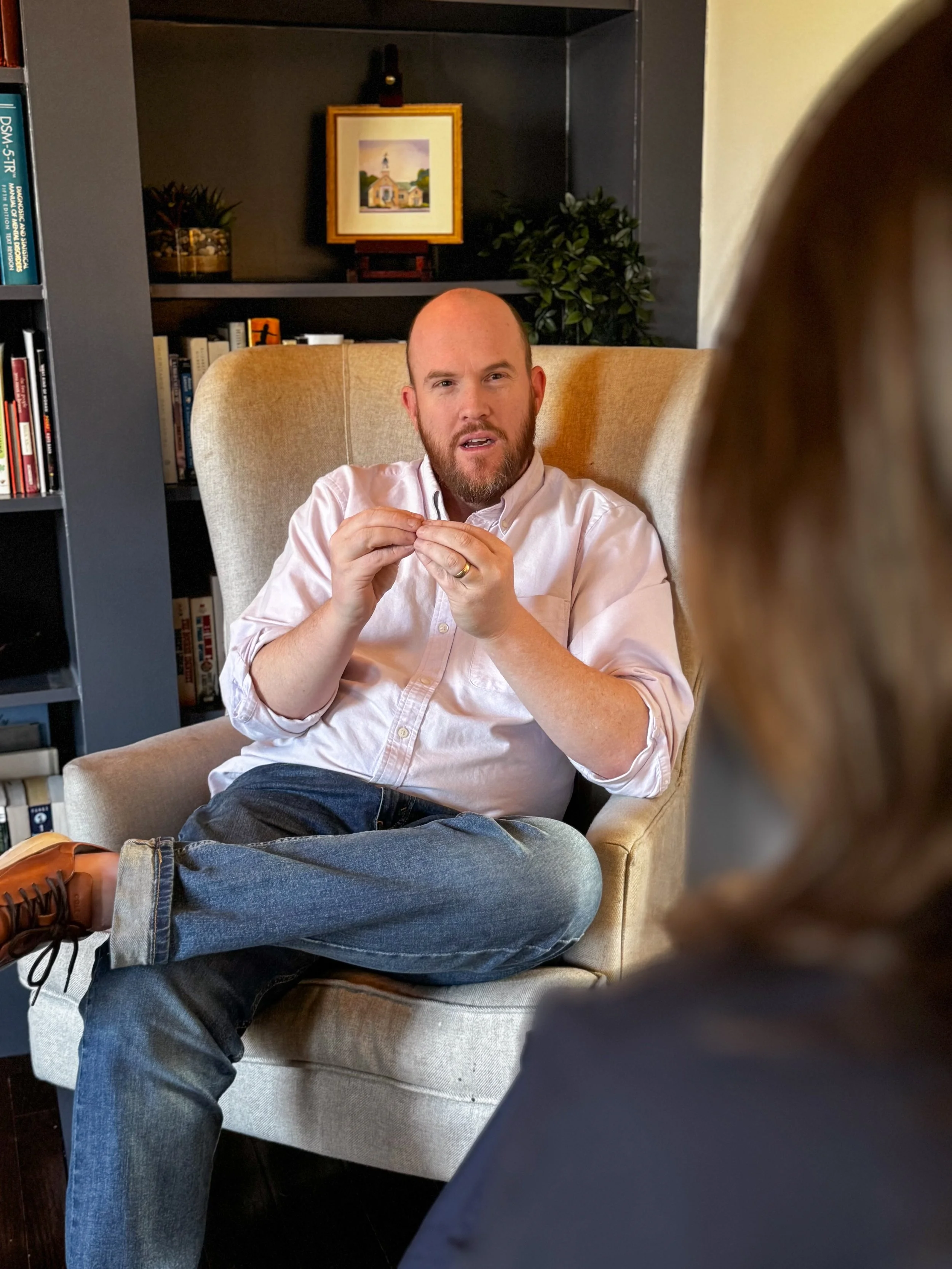
How Therapy for ROCD Works
The most effective treatment for ROCD is Exposure and Response Prevention (ERP), a form of therapy specifically designed for OCD.
Instead of trying to eliminate doubt, ERP helps you change your relationship to it.
In therapy, you learn how to:
Notice intrusive thoughts without immediately reacting to them
Resist the urge to check, analyze, or seek reassurance
Tolerate uncertainty without needing to resolve it
Over time, this reduces the intensity of the thoughts and the pull to engage with them.
Rather than trying to figure out whether your relationship is “right,” therapy helps you step out of the loop of needing to know for sure.
This approach is part of a broader method called Exposure and Response Prevention (ERP). You can learn more about ERP therapy here.
Our Approach at Red Elm
At Red Elm, we specialize in OCD and use evidence-based approaches like ERP.
Our work is structured and practical, while also being collaborative and supportive.
Many of the people we work with are thoughtful, self-aware, and used to figuring things out on their own—which can make ROCD especially frustrating. Therapy provides a different way forward.
If you’re considering therapy, you can reach out here to get started.
Frequently Asked Questions About Relationship OCD (ROCD)
How do I know if it is Relationship OCD or just the wrong relationship?
1
The key difference is not the content of the doubt, but how it functions.
In Relationship OCD (ROCD), doubts feel repetitive, intrusive, and anxiety-driven. They trigger compulsive mental behaviors such as overanalyzing feelings, scanning for certainty, seeking reassurance, comparing the relationship, or researching answers online. These cycles temporarily reduce anxiety but quickly return, creating ongoing distress and uncertainty.
In contrast, genuine relationship misalignment tends to feel more stable and integrated over time, often accompanied by clarity, emotional resolution, or a gradual decision-making process rather than repetitive mental checking and urgent need for certainty.
ROCD is characterized by a need for absolute certainty in areas where certainty is not realistically obtainable.
Will ROCD therapy force me to break up with my partner?
2
No. Effective Exposure and Response Prevention (ERP) for Relationship OCD does not direct clients to stay in or leave a relationship.
Instead, treatment targets the OCD cycle itself—specifically compulsions such as reassurance-seeking, rumination, checking feelings, and mental reviewing. As these patterns decrease, anxiety typically becomes less dominant, allowing clearer decision-making that is guided by personal values rather than fear-based urgency.
The goal of treatment is to reduce OCD-driven interference, not to determine relationship outcomes.
Can Relationship OCD occur even if my partner is loving and the relationship is healthy?
3
Yes. ROCD commonly occurs in otherwise healthy, stable, and supportive relationships.
OCD does not reflect relationship quality; it reflects how the brain responds to perceived importance and uncertainty. When a relationship is meaningful, OCD may intensify intrusive doubts such as fears about not loving a partner “enough” or worrying about being dishonest or incompatible.
The difficulty is not caused by the partner or the relationship itself, but by intrusive thoughts and compulsive responses that reinforce anxiety over time.
Does ROCD only happen in long-term relationships?
4
No. Relationship OCD can occur at any stage of a relationship, including dating, long-distance relationships, engagements, marriage, and long-term partnerships.
Symptoms often intensify during periods of increased commitment or emotional significance, such as moving in together, engagement, marriage, or major life transitions. These milestones can increase uncertainty sensitivity, which may amplify obsessive doubt and compulsive checking behaviors.
ROCD Therapy in Virginia
We offer virtual therapy across Virginia, as well as in-person sessions in Vienna.
If This Sounds Familiar
You don’t need to figure this out on your own.
If you’re feeling stuck in cycles of doubt about your relationship, therapy can help you step out of the loop and feel more grounded.