
Why OCD Feels Impossible to Stop: Understanding the Obsessive-Compulsive Cycle
At Red Elm Psychotherapy, we specialize in helping people who feel trapped in the cycle of Obsessive-Compulsive Disorder (OCD).
Many people have heard of OCD, but the reality of living with it is often misunderstood.
OCD is not simply being organized or worrying too much. It involves a cycle of unwanted thoughts, images, urges, doubts, or feelings of uncertainty—and the compulsions, avoidance, and other strategies people use to try to get relief from them.
People with OCD may recognize that their fears don't fully make sense and still find the uncertainty so distressing that it becomes incredibly difficult to resist the urge to act.
Understanding how this cycle works is the first step toward breaking it.
What is Obsessive-Compulsive Disorder?
OCD has two core components: obsessions and compulsions.
Obsessions
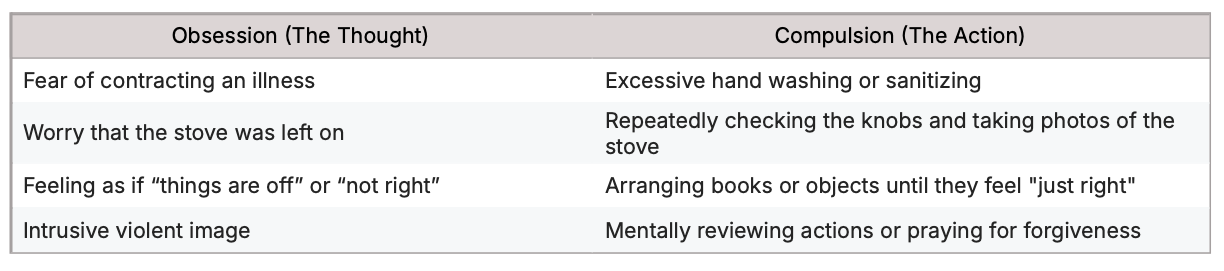
Obsessions are unwanted thoughts, images, urges, doubts, or sensations that create distress or uncertainty.
They can feel disturbing, out of character, or incredibly important to figure out. Even when you recognize that a thought doesn't reflect who you are, the uncertainty it creates can feel difficult to tolerate.
Compulsions
Compulsions are behaviors or mental rituals that someone feels driven to perform in an attempt to reduce distress, gain certainty, or prevent something bad from happening.
These behaviors may be visible, such as checking or washing, or internal, such as mentally reviewing memories, analyzing a thought, or repeating phrases in your mind.
Compulsions can bring temporary relief, but that relief can strengthen the OCD cycle over time.
Common Examples of Obsessions and Compulsions
What Is the OCD Cycle?
At its core, the OCD cycle is a self-reinforcing pattern of uncertainty or distress, followed by an attempt to get relief, followed by temporary relief that makes the cycle stronger.
It can look something like this:
1. Trigger or uncertainty
Something happens—or simply might happen—that creates doubt, fear, discomfort, or a feeling that something isn't right.
2. Distress
The uncertainty feels difficult to tolerate. You may feel anxious, alarmed, disgusted, guilty, or compelled to figure something out.
3. Compulsion, avoidance, or reassurance
You do something to make the discomfort go away or to feel more certain. This might mean checking, washing, researching, avoiding, asking for reassurance, reviewing a memory, analyzing a thought, or performing a mental ritual.
4. Temporary relief
The distress decreases, at least for a little while. It can feel like you've finally solved the problem or prevented something bad from happening.
5. The cycle gets stronger
Because the compulsion or avoidance brought relief, your brain learns that the response was important. The next time uncertainty appears, the urge to do it again can feel even stronger.
The Reinforcement Trap
This is part of what makes OCD so difficult to stop. Compulsions work in the short term—which is exactly why they can become so powerful in the long term.
The relief teaches you to keep checking, avoiding, reassuring, analyzing, or performing rituals whenever OCD creates uncertainty or distress.
Even when you recognize that the cycle isn't logical, knowing that intellectually doesn't necessarily make it easier to stop.
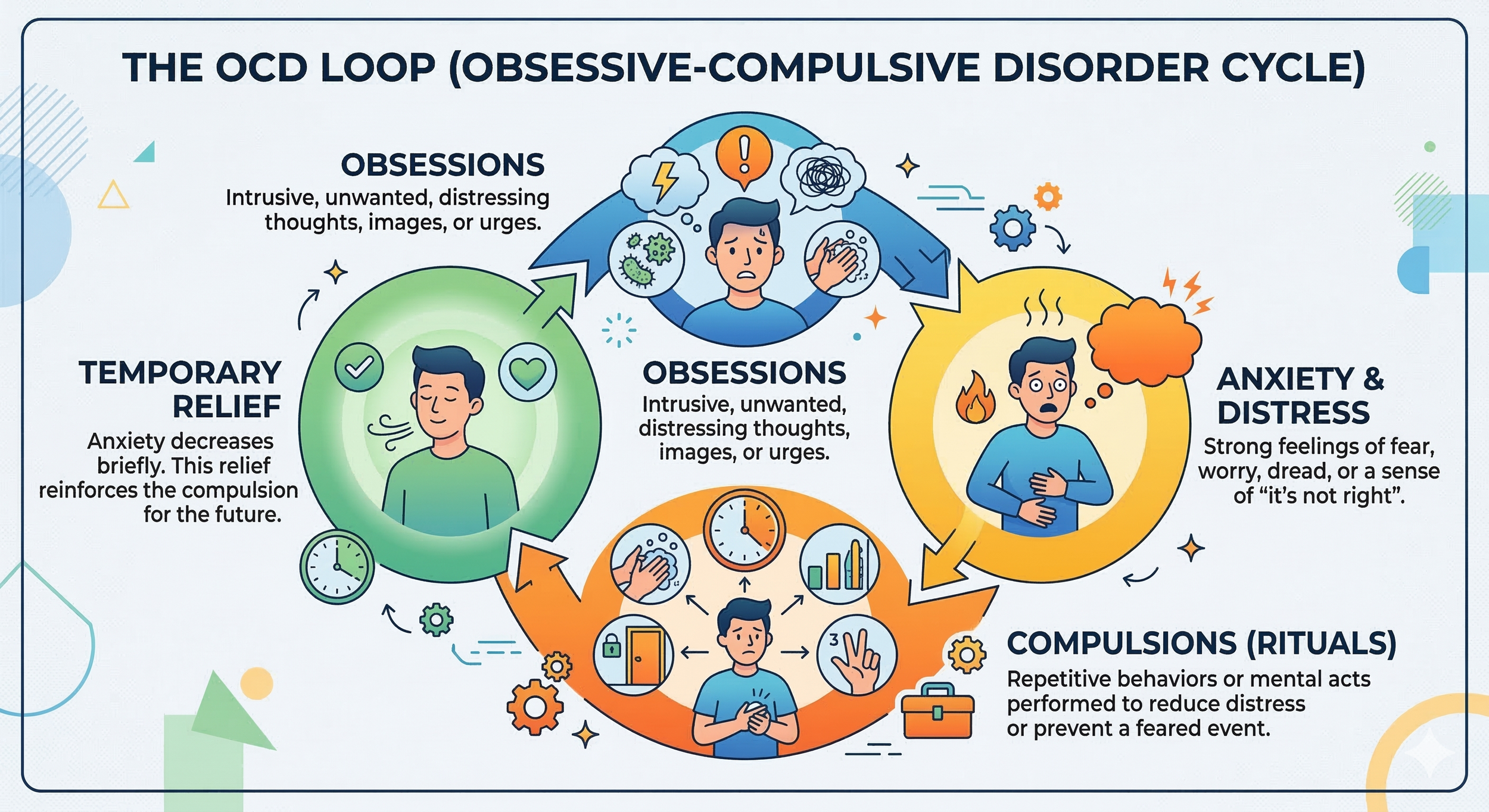
The cycle is relentless because the compulsion provides relief, which trains the brain to rely on the ritual, keeping the person trapped between their obsession and their anxiety.
Example of the OCD Cycle in Daily Life
Sarah is getting ready to leave for work when a sudden thought flashes through her mind: What if I left the stove on?
She knows she checked it before leaving the kitchen, but the uncertainty makes her uncomfortable. What if I missed something? What if the house catches fire while I'm gone?
Instead of tolerating the uncertainty, Sarah goes back to the kitchen to check the stove. She checks the burners, looks at the controls, and checks again before finally allowing herself to leave.
For a moment, she feels better. The uncertainty fades, and the anxiety drops.
But her brain has now learned that checking was important. The next time a similar doubt appears, Sarah may feel an even stronger urge to check again. Over time, she may find herself checking more often, taking longer to leave the house, or avoiding situations where she can't be completely certain that everything is safe.
The checking brought relief—but it also strengthened the cycle.
This is the pattern ERP helps interrupt: not by proving that Sarah's fear could never happen, but by helping her practice responding differently to uncertainty without automatically checking for reassurance or certainty.
Effective Treatment for OCD
The good news is that OCD is highly treatable.
One of the most effective treatments for OCD is a specialized form of cognitive behavioral therapy called Exposure and Response Prevention (ERP).
ERP helps you learn that you don't have to respond to every thought, feeling, doubt, or uncertainty with a compulsion. You can experience discomfort without automatically checking, avoiding, seeking reassurance, analyzing, or performing a ritual to make it go away.
Over time, you begin to discover that you can tolerate uncertainty and discomfort without letting OCD dictate what you do next. As this learning takes place, the cycle of OCD can begin to weaken.
About the Author
Niles Cook, PsyD, Co-Founder and Clinical Director of Red Elm Psychotherapy, is a clinical psychologist specializing in the treatment of obsessive-compulsive disorder (OCD) and anxiety disorders using Exposure and Response Prevention (ERP). He provides evidence-based OCD and anxiety treatment at Red Elm Psychotherapy in Virginia.
Ready to Take Your Life Back From OCD?
You don't have to wait until OCD gets worse to ask for help. If you're ready to understand what's keeping you stuck and explore whether ERP is right for you, we're here to help.
Schedule a consultation with Red Elm Psychotherapy to take the next step.
