

Postpartum Anxiety in Vienna, VA: What It Feels Like and How to Get Help
Postpartum anxiety can look like responsibility from the outside—but inside, it can feel constant, physical, and exhausting. Learn what postpartum anxiety feels like, when it may overlap with OCD, and how therapy in Vienna, VA can help.
Many women in Vienna and Northern Virginia are surprised by how intense postpartum anxiety can feel. You may have expected to feel joy, relief, or fulfillment after your baby arrives—but instead, you feel on edge, constantly scanning for something that could go wrong.
If anxiety has started to shape your experience of motherhood, you’re not alone—and support is available.
What Postpartum Anxiety Actually Feels Like
Anxiety after your baby arrives can change how it feels to be a mother, a partner, a friend—even yourself.
Many women notice that anxiety begins to interfere with their ability to connect with their baby or their spouse. It can feel like your mind is always “on,” even when you want to rest.
Common experiences include:
racing thoughts that are hard to slow down
constant checking (your baby’s breathing, safety, positioning)
difficulty relaxing, even when things are calm
sleep disruption—even when your baby is sleeping
For some women, these patterns begin to form a cycle of checking, reassurance, or mental reviewing that can overlap with perinatal OCD.
Why It’s So Confusing
Many of the women we work with are used to having it together. You’re thoughtful, prepared, capable.
And then suddenly, at a moment when you expected to rely on those strengths, something feels different.
You may still be functioning—taking care of your baby, managing your responsibilities—but internally, it feels like you’re working much harder just to get through the day.
Part of what makes postpartum anxiety so confusing is that it can look like responsibility.
This is especially true for women who are used to performing at a high level in other areas of their lives.
It can feel like:
“I’m just being careful”
“I should be thinking about this”
“This is what a good mom does”
But over time, the constant vigilance becomes exhausting.
Postpartum Anxiety vs. Postpartum OCD
Sometimes postpartum anxiety includes intrusive thoughts that feel disturbing or out of character.
When this happens, it can be helpful to understand the difference between anxiety and OCD.
With anxiety, thoughts often sound like:
“What if something happens to my baby?”
With OCD, thoughts may sound like:
“What if I cause something to happen to my baby?”
These thoughts are typically ego-dystonic—meaning they feel completely out of line with who you are.
When anxiety becomes paired with repetitive checking, reassurance-seeking, or mental reviewing, it may be part of a pattern of perinatal OCD.
Why It Keeps Going
One of the hardest parts of postpartum anxiety is that the things that help in the moment often keep the cycle going over time.
For example:
You check → anxiety decreases
You avoid something → anxiety decreases
You seek reassurance → anxiety decreases
Your brain learns:
👉 “This must be important—we need to keep doing this.”
Over time, this reinforces the cycle.
The problem isn’t the thoughts themselves.
It’s how your brain has learned to respond to them.
When to Get Help
You don’t have to wait until things feel unmanageable.
Many women reach out when they notice:
feeling anxious more often than not
difficulty relaxing, even when trying strategies that used to help
ongoing sleep disruption
difficulty feeling connected to their baby
feeling stuck in cycles of worry, checking, or mental loops
Postpartum Anxiety Therapy in Vienna, VA
We provide therapy for postpartum anxiety in Vienna, Virginia, and work with clients throughout Northern Virginia and across the state via telehealth.
Treatment is structured, collaborative, and grounded in evidence-based approaches that help reduce anxiety while supporting you in reconnecting with your life and your role as a parent.
If this resonates, you can reach out to schedule a consultation.
About the Author
Dr. Erin Cook is a clinical psychologist and co-founder of Red Elm Psychotherapy, a Virginia-based practice specializing in perinatal mental health and OCD. She works with women navigating pregnancy, postpartum, and early motherhood—especially when anxiety or intrusive thoughts feel overwhelming or out of character.
Her approach is thoughtful, collaborative, and grounded in helping clients feel less alone in what they’re experiencing.

Why ERP Feels So Hard (And Why That Means It’s Working)
You know the thoughts don’t make sense—but they still feel urgent. This is why ERP feels so hard, and why that discomfort is actually part of getting better.
If you’re reading this, you probably already know that your intrusive thoughts don’t make sense. You know the logic is flawed. You know that checking the stove for the fifth time or replaying that conversation in your head won’t actually change the outcome.
Logic isn't the problem.
The problem is that these thoughts feel urgent, important, and impossible to ignore. They don't feel like "just thoughts"—they feel like fires that need to be put out right now.
The Loop You’re Stuck In
Most people try to think their way out of OCD. You analyze. You Google. You seek reassurance from your partner. You replay the "evidence" over and over.
And for a second, it works. The anxiety dips. You feel a brief moment of "certainty."
But then the doubt creeps back in. “But what if I missed something? What if this time is different?” This is the OCD cycle of Obsession → Compulsion → Temporary Relief. Every time you perform a compulsion to feel safe, you are accidentally teaching your brain that the "threat" was real. You are feeding the monster to keep it quiet, but the monster only gets hungrier.
Reclaiming Your Brain: What ERP Actually Is
Most clinical descriptions of Exposure and Response Prevention (ERP) make it sound like a chore. In reality, ERP is a rebellion. ERP is not about "getting rid of thoughts." (Spoiler: you can't control what pops into your head). It’s about changing your relationship to those thoughts. It means doing the exact opposite of what your brain is screaming at you to do.
What ERP Feels Like in Practice:
Letting a thought sit in your mind without trying to "answer" it or solve it.
Resisting the urge to check—whether that’s a door lock, a physical sensation, or a memory.
Staying in the discomfort of uncertainty instead of chasing the high of reassurance.
Why It Feels "Wrong"
Here is the truth that most textbooks won't tell you: Doing ERP feels irresponsible.
When you stop performing your compulsions, your brain will tell you that you’re being careless. It will tell you that you’re ignoring something dangerous. It will feel like you are walking a tightrope without a net.
That feeling? That’s the feeling of your brain re-wiring itself. If it feels "right" and comfortable, you aren't doing ERP. When it feels risky and uncertain, you are finally interrupting the cycle that has kept you stuck for years.
Is ERP Therapy Hard?
Because ERP is the "gold standard" for OCD treatment, people often ask if the process is as intense as it sounds. The short answer is: Yes, ERP is hard because it requires you to intentionally lean into uncertainty rather than running away from it.
However, "hard" doesn't mean "reckless." In our practice, we don't throw you into the deep end. We use a fear hierarchy to help you face challenges in a structured way. The goal isn't just to be "brave"—it’s to retrain your brain's alarm system so that eventually, the things that feel impossible today become background noise.
Stop Analyzing. Start Living.
OCD thrives on the "What If." ERP thrives on the "So What?" By leaning into the uncertainty, you stop being a prisoner to your own thoughts. You stop managing your anxiety and start living your life again.
By leaning into the uncertainty, you stop being a prisoner to your own thoughts. You stop managing your anxiety and start living your life again.
Dr. Niles Cook specializes in treating OCD using evidence-based Exposure and Response Prevention (ERP). He works with adults across the full spectrum of OCD presentations, helping them move past the "mental loops" and back into the driver’s seat.
If this feels familiar, you don’t have to keep managing it alone.
We offer evidence-based OCD treatment for adults across Virginia.
If you’re experiencing this during pregnancy or postpartum, you can learn more about our postpartum and perinatal therapy here.

Why Do Intrusive Thoughts Feel So Real Postpartum?
Intrusive thoughts after having a baby can feel frighteningly real. This post explains why postpartum intrusive thoughts happen, what they mean, and how to begin stepping out of the cycle.
One of the most distressing parts of postpartum intrusive thoughts isn’t just what they are—it’s how real they feel.
Many women experience intrusive thoughts after birth that feel confusing, unfamiliar, and deeply out of character. These thoughts often show up as sudden “what if” scenarios:
What if I drop the baby?
What if I lose control?
What if I accidentally hurt them without meaning to?
The mental strain of trying to understand or prevent these thoughts is often compounded by the realities of postpartum life—sleep deprivation, feeding challenges, physical recovery, relationship shifts, and caring for other children.
Why Do Postpartum Intrusive Thoughts Feel So Convincing?
Intrusive thoughts don’t just feel like random mental noise. They often feel like signals—something important, something meaningful, something you need to pay attention to.
This is a key feature of postpartum anxiety and postpartum OCD—the thoughts feel urgent and believable, even when they don’t reflect your intentions.
What’s Actually Happening in the Brain
When an intrusive thought appears, it can quickly activate the brain’s threat detection system.
Your brain automatically asks:
“Is this dangerous? Do I need to act?”
When a thought is flagged as even possibly important:
Attention locks onto it → it becomes hard to ignore
Anxiety increases → your body responds as if something is wrong
The thought feels meaningful → it no longer feels like “just a thought”
This is part of your brain’s built-in alarm system. Its job is to keep you and your baby safe—but it doesn’t distinguish well between a thought about harm and actual danger.
This same alarm process is a core feature of OCD, where intrusive thoughts become “sticky” because they’re treated as meaningful or threatening. You can read more about how this pattern works in the OCD cycle here.
Why Intrusive Thoughts Can Feel Stronger After Birth
The postpartum period is a time of increased vulnerability, responsibility, and change.
Your brain adapts by becoming more alert to potential threats:
You are caring for a completely dependent baby
The stakes feel high and constant
Your daily structure and identity are shifting
This heightened awareness is protective—but it also means your brain is:
More likely to scan for “what if” scenarios
Less able to dismiss unlikely thoughts
More reactive to uncertainty
At the same time, sleep deprivation and physical recovery can make it harder to step back from anxious thinking.
For many high-functioning women, there’s an added layer: you’re used to feeling capable and in control. Postpartum can feel unfamiliar and high-stakes, which makes intrusive thoughts feel even more unsettling and important.
What Intrusive Thoughts Actually Mean
Intrusive thoughts feel true because of how your brain responds to them—not because they reflect your intentions.
In fact, postpartum intrusive thoughts often target what you care about most.
The more you care about your baby’s safety
The more responsible you feel
The more seriously you take motherhood
…the more likely your brain is to generate distressing “what if” thoughts in those exact areas.
This is not a sign that you want something to happen.
It’s a sign that your brain is trying—imperfectly—to protect what matters most.
Intrusive thoughts target what you care about, not what you want.
When Intrusive Thoughts Become Postpartum OCD
For many women, the distress isn’t just the thoughts—it’s what follows.
You may find yourself:
Analyzing what the thought “means”
Checking your reactions
Avoiding certain situations
Seeking reassurance
Trying to suppress or neutralize the thought
These responses are completely understandable—but they can unintentionally reinforce the cycle.
Over time, this can develop into postpartum OCD, where the pattern looks like:
Intrusive thought → anxiety → attempt to control or get certainty → temporary relief → thought returns stronger
This cycle is common—and highly treatable with the right support.
You’re Not Alone—and This Is Treatable
If you’re experiencing intrusive thoughts during pregnancy or postpartum, you are not alone—and this does not mean something is wrong with you.
These thoughts are a reflection of a brain that is trying to protect, not harm.
With the right support, it’s possible to feel less caught in the cycle and more grounded in your role as a parent.
To learn more, explore our pages on perinatal OCD and ERP therapy for OCD.
If This Feels Familiar
If you’re noticing intrusive thoughts that feel hard to shake, you don’t have to navigate this alone.
Many women experience this in the postpartum period—and with the right support, it can become much more manageable.
If you’d like to learn more or see if working together feels like a good fit, you can contact Red Elm Psychotherapy to get started.
About the Author
Dr. Erin Cook is a clinical psychologist and co-founder of Red Elm Psychotherapy, a Virginia-based practice specializing in perinatal mental health and OCD. She works with women navigating pregnancy, postpartum, and early motherhood—especially when anxiety or intrusive thoughts feel overwhelming or out of character.
Her approach is thoughtful, collaborative, and grounded in helping clients feel less alone in what they’re experiencing.
Why OCD Feels Impossible to Stop: Understanding the Obsessive-Compulsive Cycle
Obsessive-Compulsive Disorder (OCD) traps people in a cycle of intrusive thoughts, anxiety, and compulsions. Learn how the OCD cycle works and how evidence-based treatment can help break it.
At Red Elm Psychotherapy, we specialize in helping people who feel trapped in the cycle of Obsessive-Compulsive Disorder (OCD).
Many people have heard of OCD, but the reality of living with it is often misunderstood.
OCD is not simply being organized or worrying too much. It involves a cycle of unwanted thoughts, images, urges, doubts, or feelings of uncertainty—and the compulsions, avoidance, and other strategies people use to try to get relief from them.
People with OCD may recognize that their fears don't fully make sense and still find the uncertainty so distressing that it becomes incredibly difficult to resist the urge to act.
Understanding how this cycle works is the first step toward breaking it.
What is Obsessive-Compulsive Disorder?
OCD has two core components: obsessions and compulsions.
Obsessions
Obsessions are unwanted thoughts, images, urges, doubts, or sensations that create distress or uncertainty.
They can feel disturbing, out of character, or incredibly important to figure out. Even when you recognize that a thought doesn't reflect who you are, the uncertainty it creates can feel difficult to tolerate.
Compulsions
Compulsions are behaviors or mental rituals that someone feels driven to perform in an attempt to reduce distress, gain certainty, or prevent something bad from happening.
These behaviors may be visible, such as checking or washing, or internal, such as mentally reviewing memories, analyzing a thought, or repeating phrases in your mind.
Compulsions can bring temporary relief, but that relief can strengthen the OCD cycle over time.
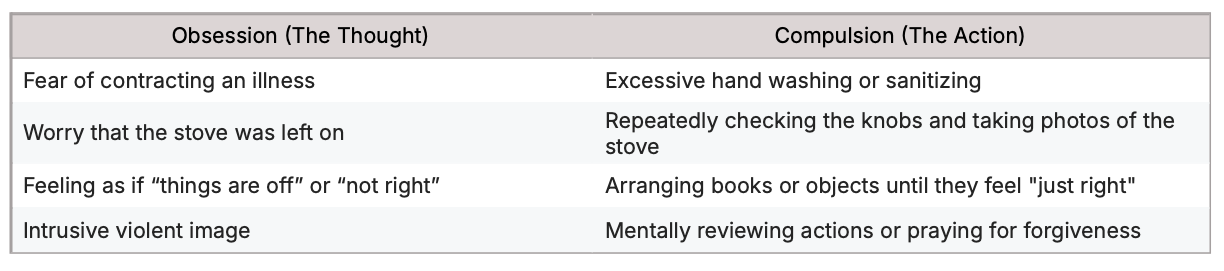
Common Examples of Obsessions and Compulsions
What Is the OCD Cycle?
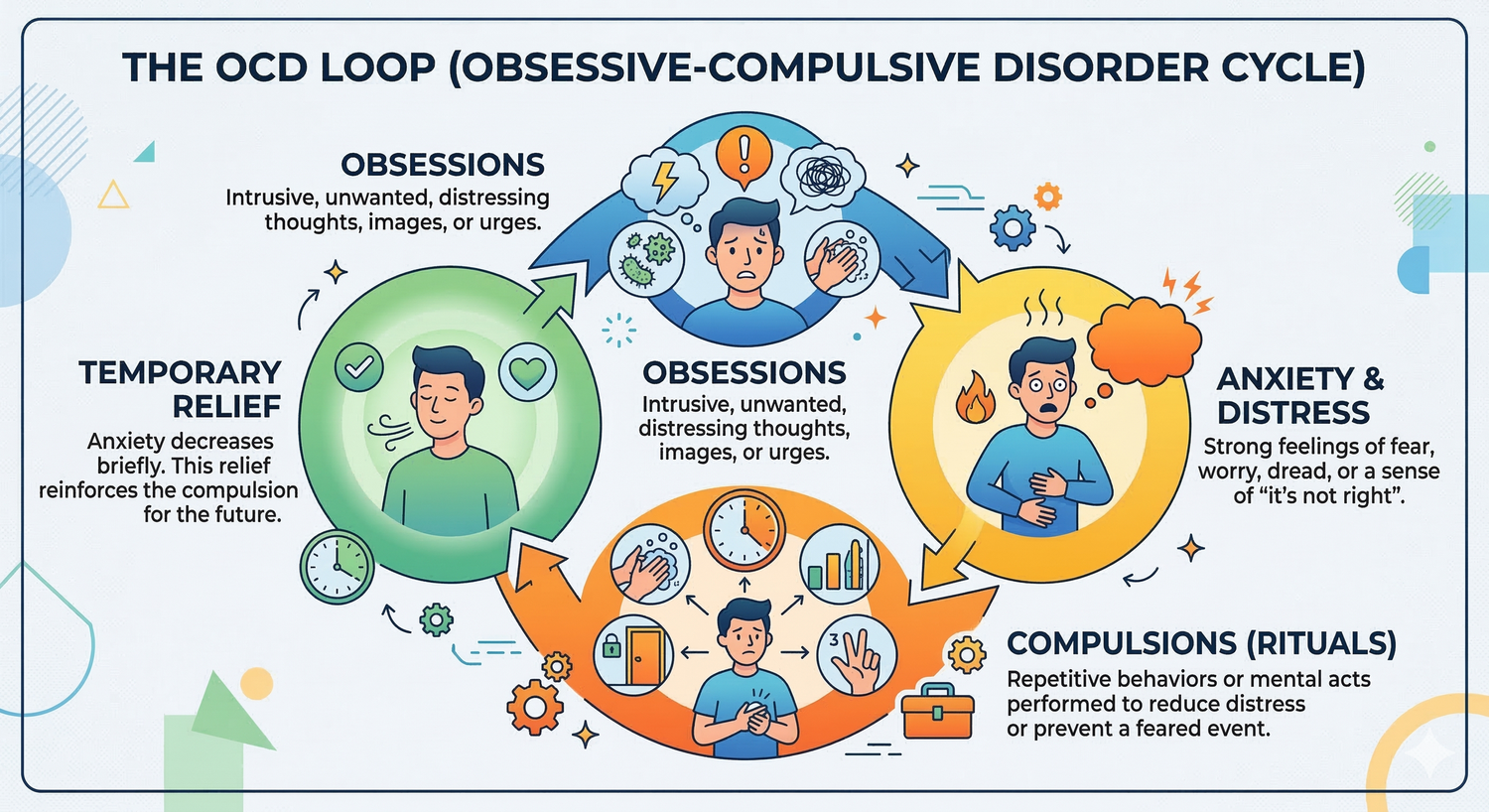
At its core, the OCD cycle is a self-reinforcing pattern of uncertainty or distress, followed by an attempt to get relief, followed by temporary relief that makes the cycle stronger.
It can look something like this:
1. Trigger or uncertainty
Something happens—or simply might happen—that creates doubt, fear, discomfort, or a feeling that something isn't right.
2. Distress
The uncertainty feels difficult to tolerate. You may feel anxious, alarmed, disgusted, guilty, or compelled to figure something out.
3. Compulsion, avoidance, or reassurance
You do something to make the discomfort go away or to feel more certain. This might mean checking, washing, researching, avoiding, asking for reassurance, reviewing a memory, analyzing a thought, or performing a mental ritual.
4. Temporary relief
The distress decreases, at least for a little while. It can feel like you've finally solved the problem or prevented something bad from happening.
5. The cycle gets stronger
Because the compulsion or avoidance brought relief, your brain learns that the response was important. The next time uncertainty appears, the urge to do it again can feel even stronger.
The Reinforcement Trap
This is part of what makes OCD so difficult to stop. Compulsions work in the short term—which is exactly why they can become so powerful in the long term.
The relief teaches you to keep checking, avoiding, reassuring, analyzing, or performing rituals whenever OCD creates uncertainty or distress.
Even when you recognize that the cycle isn't logical, knowing that intellectually doesn't necessarily make it easier to stop.
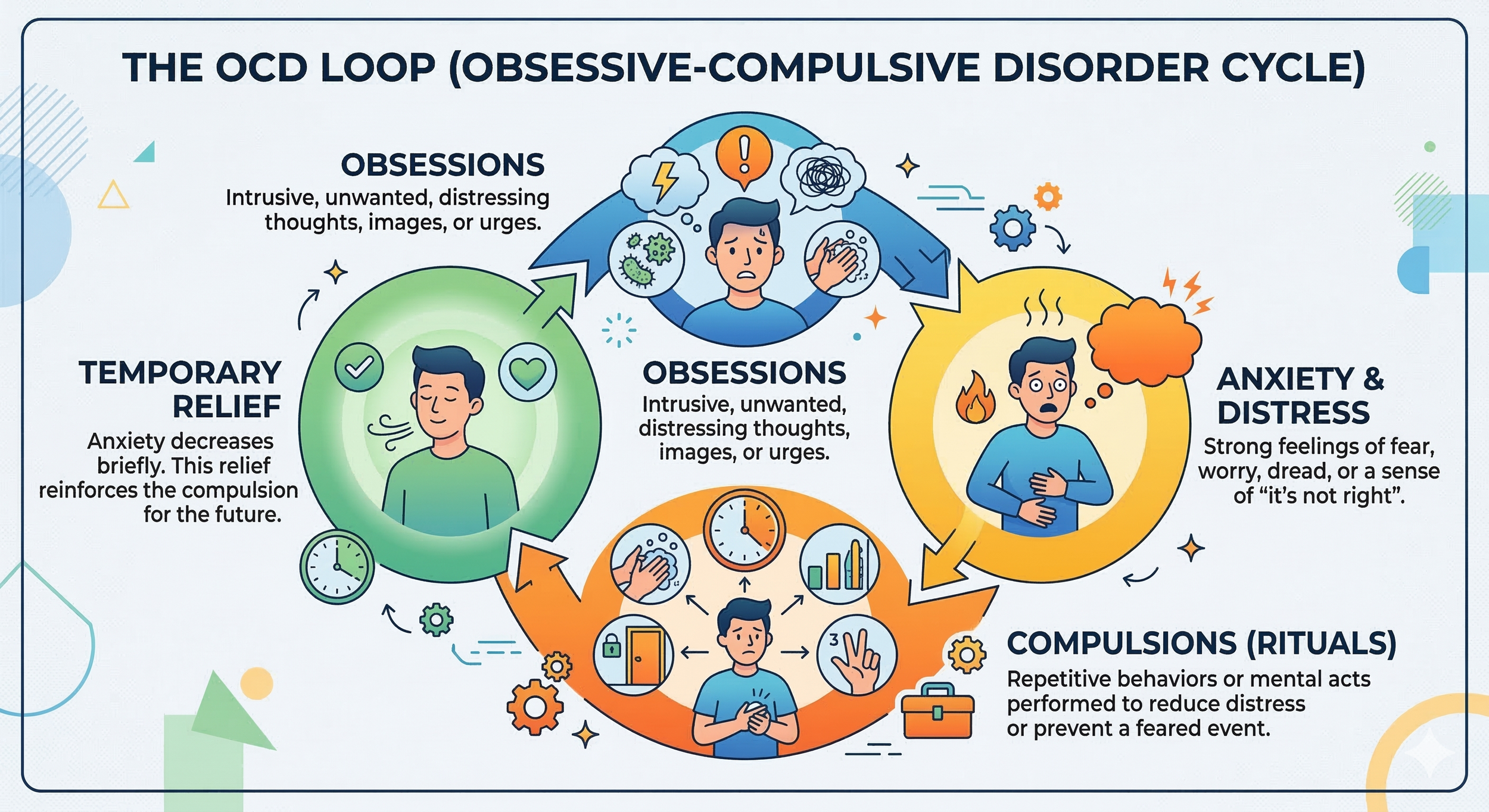
The cycle is relentless because the compulsion provides relief, which trains the brain to rely on the ritual, keeping the person trapped between their obsession and their anxiety.
Example of the OCD Cycle in Daily Life
Sarah is getting ready to leave for work when a sudden thought flashes through her mind: What if I left the stove on?
She knows she checked it before leaving the kitchen, but the uncertainty makes her uncomfortable. What if I missed something? What if the house catches fire while I'm gone?
Instead of tolerating the uncertainty, Sarah goes back to the kitchen to check the stove. She checks the burners, looks at the controls, and checks again before finally allowing herself to leave.
For a moment, she feels better. The uncertainty fades, and the anxiety drops.
But her brain has now learned that checking was important. The next time a similar doubt appears, Sarah may feel an even stronger urge to check again. Over time, she may find herself checking more often, taking longer to leave the house, or avoiding situations where she can't be completely certain that everything is safe.
The checking brought relief—but it also strengthened the cycle.
This is the pattern ERP helps interrupt: not by proving that Sarah's fear could never happen, but by helping her practice responding differently to uncertainty without automatically checking for reassurance or certainty.
Effective Treatment for OCD
The good news is that OCD is highly treatable.
One of the most effective treatments for OCD is a specialized form of cognitive behavioral therapy called Exposure and Response Prevention (ERP).
ERP helps you learn that you don't have to respond to every thought, feeling, doubt, or uncertainty with a compulsion. You can experience discomfort without automatically checking, avoiding, seeking reassurance, analyzing, or performing a ritual to make it go away.
Over time, you begin to discover that you can tolerate uncertainty and discomfort without letting OCD dictate what you do next. As this learning takes place, the cycle of OCD can begin to weaken.
About the Author
Niles Cook, PsyD, Co-Founder and Clinical Director of Red Elm Psychotherapy, is a clinical psychologist specializing in the treatment of obsessive-compulsive disorder (OCD) and anxiety disorders using Exposure and Response Prevention (ERP). He provides evidence-based OCD and anxiety treatment at Red Elm Psychotherapy in Virginia.
Ready to Take Your Life Back From OCD?
You don't have to wait until OCD gets worse to ask for help. If you're ready to understand what's keeping you stuck and explore whether ERP is right for you, we're here to help.
Schedule a consultation with Red Elm Psychotherapy to take the next step.

Is It Normal to Have Intrusive Thoughts About Harming Your Baby?
Many new mothers experience frightening intrusive thoughts after their baby is born. These thoughts can feel disturbing and isolating, but they are far more common than most women realize. Learn why these thoughts happen, when they are normal, and when they may be part of postpartum OCD.
Postpartum Intrusive Thoughts, Anxiety, and OCD—What’s Normal and What’s Not
If you’ve had a sudden, disturbing thought about harming your baby, you are not alone—and it does not mean you want to act on it. In fact, these thoughts are far more common than most people realize.
Many women are surprised by the kinds of intrusive thoughts that can show up after a baby is born.
Sudden images of their baby being hurt.
Fears that their baby might fall, get sick, or stop breathing.
Thoughts about accidentally harming their baby while caring for them.
Or frightening thoughts about causing harm themselves.
These experiences can take many forms, but they often center around a baby’s safety.
For many mothers, these thoughts feel deeply disturbing and isolating—like you’re the only person who has ever experienced something like this.
While fears about the baby are most common, postpartum OCD can also show up as:
Intense doubts about your partner or your relationship (Relationship OCD).
Severe guilt or fears about being an "immoral" person (Scrupulosity).
Sudden images of the baby being hurt or falling.
Are Intrusive Thoughts After Baby Normal?
In reality, intrusive thoughts in the postpartum period are extremely common. In a large study from Canada, researchers found that 95% of new mothers had thoughts about their baby being accidentally harmed, and more than half had thoughts about harming their baby themselves.
These experiences are intrusive, meaning they appear suddenly and feel unwanted or upsetting. Mothers who experience them are usually frightened by them and wish they would go away.
Many mothers tell me the most frightening part isn’t the thought itself, but the fear that having the thought might mean something about who they are as a mother.
Having these thoughts does not mean that you will harm your baby.
In fact, the opposite is often true. Mothers who experience these thoughts are often deeply concerned about their baby’s safety and may be working very hard to prevent anything bad from happening.
The fact that the thoughts feel upsetting or frightening is often a sign that you care deeply about keeping your baby safe.
Intrusive thoughts in postpartum anxiety and OCD are very different from the rare condition postpartum psychosis. In OCD, the thoughts feel unwanted and frightening, and mothers are typically trying very hard to prevent anything bad from happening.
Why Do These Thoughts Happen?
After birth, a mother’s brain undergoes major shifts.
Your brain becomes much more sensitive to potential threats. Hormones strengthen your bond with your baby, but they also heighten vigilance around your baby’s safety.
At the same time, your brain begins to simulate possible danger scenarios.
In many ways this makes sense. Protecting your baby becomes one of your brain’s most important priorities during this period.
But when these changes combine with sleep deprivation, feeding challenges, birth trauma, physical recovery, relationship changes, high-risk pregnancies, pregnancy after loss, medically complex babies, or pelvic floor injuries, these thoughts can begin to feel overwhelming.
Many mothers naturally try to push these thoughts away or analyze what they might mean. Unfortunately, both of these strategies can make the thoughts come back even more strongly.
Sometimes they also start to feel sticky.
When Intrusive Thoughts May Be Postpartum OCD
For some mothers, these thoughts begin to get stuck.
Instead of coming and going, they start to trigger intense anxiety and feel harder to dismiss. When this happens, the thoughts may be part of a larger pattern called perinatal OCD.
A sudden thought like:
“What if I drop my baby down the stairs?”
can feel incredibly distressing.
In response, a mother might begin avoiding situations that trigger the thought — for example avoiding carrying her baby on the stairs altogether.
Many mothers also begin avoiding everyday caregiving situations where these thoughts tend to appear: walking on stairs, bathing the baby, feeding them, or holding them near balconies or sharp objects.
If avoidance isn’t possible, she may try to manage the anxiety in other ways. She might count each step as she walks down the stairs, repeat reassuring phrases in her mind, or mentally check whether she feels “in control.”
While these strategies may reduce anxiety in the moment, they unintentionally teach the brain that the thought was dangerous and needed to be controlled.
Over time, the cycle reinforces itself.
How Treatment Helps
The most effective treatment for OCD is Exposure and Response Prevention (ERP).
ERP helps mothers gradually face the situations that trigger their fears while learning to stop the avoidance, reassurance seeking, and rituals that keep anxiety stuck.
For example, treatment might involve gradually practicing carrying your baby on the stairs again while learning not to rely on counting, reassurance, or other rituals to reduce anxiety.
Over time, the brain learns something new: these thoughts are not dangerous and do not need to be controlled.
ERP is highly effective, and it is safe for both mothers and their babies.
With the right support, many mothers recover fully from postpartum OCD and are able to enjoy their babies and their lives again.
If You're Struggling
If intrusive thoughts have started to feel overwhelming or are taking away from the joy of early parenthood, you are not alone.
Support can help. Our clinic specializes in postpartum and perinatal therapy with an emphasis on perinatal OCD and anxiety, and we work with mothers who are experiencing exactly these kinds of thoughts.