

Is It Perfectionism, or Is It "Just Right" OCD?
"For a long time, your attention to detail may have felt like one of your greatest strengths. But somewhere along the way, what once felt helpful started feeling exhausting. If your brain won’t let you move on until a task, an email, or a space feels 'just right,' you aren't just a perfectionist—and you aren't alone. Here is how to break the loop."
For a long time, your attention to detail may have felt like one of your greatest strengths.
You were the person who caught mistakes other people missed. The person who cared deeply. The person who stayed up a little later, worked a little harder, and pushed things a little further.
Maybe those qualities helped you succeed in school, build a career, care for your family, or create a life you're proud of.
But somewhere along the way, what once felt helpful started feeling exhausting.
You spend twenty minutes writing an email that should take two.
You can't stop thinking about a conversation from yesterday because something about it still feels unsettled.
You reorganize the same space over and over, searching for a feeling of completion that never quite arrives.
You tell yourself, "Just finish it and move on."
But your brain won't let you.
When "Doing Your Best" Stops Feeling Like a Choice
Many people assume OCD is always about contamination fears or checking behaviors. But for some people, OCD shows up as an overwhelming need for things to feel right.
Not perfect in the traditional sense.
Just right.
It can feel like an internal tension, a sense that something is unfinished, uneven, incomplete, or off.
You may not be worried that something terrible will happen if you leave it alone.
The problem is that leaving it alone can feel almost physically uncomfortable.
So you rewrite.
You reread.
You replay.
You rearrange.
You try one more time.
And then one more.
Not because you want to—but because you're desperately trying to get rid of that uncomfortable feeling.
The Part That People Don't See
From the outside, people often assume you're organized, conscientious, or highly motivated.
What they don't see is how much energy the OCD cycle takes.
The mental loops.
The second-guessing.
The way simple tasks can consume enormous amounts of time.
The frustration of knowing you're capable of more but feeling stuck in endless revisions and re-doing.
Many of the professionals and parents we work with describe feeling trapped between two realities:
Part of them knows they're spending too much time on something.
Another part feels completely unable to stop.
That tug-of-war can be exhausting.
Why the Relief Never Lasts
The difficult thing about chasing the "just right" feeling is that it rarely stays.
Maybe you finally send the email.
Maybe you finally organize the room.
Maybe you finally find the exact wording you've been searching for.
There's a brief sense of relief.
And then your brain starts looking for the next thing that's off.
The next thing that needs adjusting.
The next thing that doesn't quite feel complete.
Over time, life can start to shrink around those moments.
Not because you're lazy.
Not because you're incapable.
But because so much energy is going toward managing discomfort.
Learning to Live With "Good Enough"
One of the hardest truths about "Just Right" OCD is that the goal isn't to make everything feel right.
The goal is learning that you can tolerate the feeling when it doesn't.
That might mean sending the email before it feels finished.
Leaving the picture frame slightly crooked.
Walking away from a task when it's good enough.
Not because you don't care.
Because your life is bigger than the pursuit of certainty, completeness, or perfect alignment.
Through Exposure and Response Prevention (ERP), people gradually learn something surprising:
The discomfort doesn't last forever.
And they don't have to keep obeying it.
When You're Ready for More Freedom
If you're exhausted by the constant revising, rethinking, redoing, or striving for a feeling that never quite arrives, you're not alone.
Many high-achieving professionals and parents find themselves caught in these patterns.
The good news is that change doesn't require lowering your standards or becoming someone who doesn't care.
It means learning how to care deeply about your work, your family, and your values without being controlled by the need for everything to feel exactly right.
f you're looking for support in Northern Virginia, specialized OCD therapy can help you step off the treadmill. Reach out to our Vienna, VA office to connect with Niles Cook, PsyD today and reclaim your time, energy, and peace of mind.
Prefer to meet online? While we love seeing clients face-to-face in our Vienna office, we also provide specialized online OCD therapy and ERP services virtually across Virginia and all PSYPACT-participating states.
About the Author
Dr. Niles Cook is a clinical psychologist specializing in OCD and anxiety disorders, with advanced training in Exposure and Response Prevention. At Red Elm Psychotherapy, he helps adults across Virginia understand their OCD cycle, reduce compulsions, and build a more flexible relationship with fear, doubt, and uncertainty.

Trying to Conceive Without Losing Yourself: Understanding Fertility Anxiety and OCD
For many women, the emotional journey into parenthood begins long before a positive pregnancy test. When the path to pregnancy becomes consumed by an exhausting cycle of anxiety, hyper-tracking, and a search for certainty, you aren't just stressed—your mind may be caught in an OCD loop. Learn how to carry hope without losing yourself in the process.
For many women, becoming pregnant isn't as straightforward as they imagined.
After years of preventing pregnancy, it can be startling to discover how much uncertainty is involved in trying to conceive (TTC). What many expected to be a simple next step can instead become months or years of planning, medical appointments, fertility treatments, disappointments, and difficult waiting.
For some women, the emotional journey into parenthood begins long before a positive pregnancy test.
Feeling anxious during this process is completely understandable. When something matters deeply, uncertainty naturally feels difficult. But sometimes anxiety becomes more than worry. Thoughts become "sticky." Reassurance never seems to last. Tracking starts to consume more and more time.
For some individuals, the struggle is not just fertility-related stress. It is anxiety or OCD attaching itself to fertility and reproduction.
When Anxiety Becomes a Full-Time Job
Many women experiencing fertility-focused anxiety appear thoughtful, informed, and responsible from the outside. They know the details of their cycle. They have researched treatment options. They are paying close attention to their health.
But internally, they may feel trapped in a cycle of fear and vigilance, constantly wondering:
What if my body is broken?
What if I waited too long?
What if something I did years ago affected my fertility?
What if I missed my fertile window?
What if this symptom means something important?
What if I never become a parent?
These thoughts often feel urgent, important, and impossible to ignore.
The OCD Cycle and Fertility
OCD thrives wherever certainty is impossible—and fertility is full of uncertainty.
Even with excellent medical care, perfect timing, and healthy reproductive systems, no one can guarantee a specific outcome. For someone vulnerable to OCD, that uncertainty can feel unbearable.
When applied to the reproductive journey, the OCD cycle typically looks like this:
1. The Obsession: An intrusive thought or image appears suddenly.
“What if I accidentally ruined my chances of getting pregnant this month?”
2. The Compulsion: To feel more certain, safe, or in control, you engage in a physical or mental behavior. You search online for hours, compare your experience to others on forums, analyze physical symptoms repeatedly, check fertility tracking apps over and over, or mentally review past decisions.
3. Temporary Relief: Your anxiety decreases briefly because you found a "reassuring" piece of data.
4. The Return of Doubt: A new "what-if" appears. “But what if that information was wrong? What if I misread the test?” And the loop starts all over again.
Unfortunately, every attempt to eliminate uncertainty accidentally teaches the brain that uncertainty is dangerous and must be solved immediately.
What Fertility OCD Can Look Like
Because fertility tracking is often medically recommended, it can be incredibly difficult to recognize when helpful monitoring has shifted into compulsive, anxiety-driven monitoring.
Hyper-Tracking
Tracking becomes difficult to stop even when it no longer feels useful. You may find yourself checking multiple apps, taking repeated ovulation tests long after your peak, recording every minor bodily sensation, and constantly comparing current and past cycles.
Somatic Hyperawareness
Your attention becomes glued to your body. Every cramp, twinge, headache, or wave of nausea feels potentially significant. You may spend large portions of the day trying to determine what these symptoms "mean" during the grueling two-week wait.
Reassurance Seeking
You repeatedly look for certainty from partners, friends, healthcare providers, online communities, fertility forums, and search engines. The reassurance helps briefly, but the relief never seems to last.
Mental Reviewing
You replay events repeatedly in your head: Did I time intercourse correctly? Did I eat something harmful? Did I exercise too much? Did I miss an important sign? Instead of creating clarity, this mental reviewing only creates more doubt.
Why "Just Relax" Doesn't Help
Women trying to conceive are frequently given well-intentioned but deeply frustrating advice: "Just stop thinking about it," "Relax and it will happen," or "Stress is probably making it harder."
While usually meant to be comforting, these comments can leave people feeling blamed and isolated. For someone struggling with anxiety or OCD, "just relax" simply creates another impossible task. Now there is a new fear: “What if my anxiety is the reason I’m not pregnant?”
The result is a cruel loop of anxiety about anxiety. No one can simply decide not to care about something deeply meaningful.
Fertility Challenges and Real Losses
It's also vital to acknowledge that fertility anxiety does not occur in a vacuum. Many women navigating these challenges have also experienced:
Failed fertility treatments (failed IUI or IVF cycles)
Reproductive trauma
In these situations, fears are not coming from nowhere. The goal of therapy is not to convince you that everything will be fine. The goal is to help you carry uncertainty, grief, fear, and hope without becoming trapped in endless, exhausting attempts to control what cannot be fully controlled.
Fertility OCD, Pregnancy OCD, and Postpartum OCD
One reason fertility OCD often goes unrecognized is that many people assume the symptoms will automatically disappear once pregnancy occurs. Sometimes they do—but often, the underlying themes simply shift.
The fear easily moves from "What if I can't get pregnant?" to "What if I harm this pregnancy?" and later, topostpartum intrusive thoughtslike "What if I harm my baby?"
This is one reason specialized perinatal and postpartum mental health care can be so valuable. Understanding OCD across the reproductive journey allows treatment to address the underlying psychological process rather than only chasing the current, shifting fear.
Reclaiming Your Life While Trying to Conceive
The goal of therapy is not to stop caring about becoming pregnant. The goal is to stop allowing anxiety and OCD to take over your life while you wait.
With specialized, evidence-based treatment, many women learn how to:
Reduce compulsive tracking and checking behaviors
Respond differently to intrusive, sticky thoughts
Tolerate uncertainty without endless reassurance seeking
Stay anchored and present during the two-week wait
Separate their inherent worth from reproductive outcomes
Continue building a meaningful, vibrant life while pursuing parenthood
Trying to conceive is already hard enough. You shouldn't have to spend the process battling your own mind every day. If fertility anxiety or OCD has begun to consume your thoughts, relationships, or daily functioning, support is available. You do not have to navigate the uncertainty of this journey alone.
Not sure whether it's anxiety, OCD, or something else?
Many women assume their fertility worries are "just part of trying to conceive." A consultation with a therapist trained in perinatal mental health can help you better understand what you're experiencing and what treatment approach may be most helpful.
Reach out to schedule a consultation today.
Looking for professional support on your journey? Learn more about our specialized Fertility Therapy Services.
About the Author:
Dr. Erin Cook, PsyD, PMH-C is a licensed psychologist and Certified Perinatal Mental Health specialist at Red Elm Psychotherapy. Grounded in evidence-based care, her clinical practice includes helping individuals navigate anxiety, OCD, and complex transitions across the entire reproductive journey—from preconception and fertility challenges through pregnancy and the postpartum period.

The Parent’s Guide to Admissions Testing in Northern Virginia: WISC-V vs. WAIS-5
Navigating private school admissions in Northern Virginia can quickly feel overwhelming. Learn what cognitive testing your child actually needs, the critical differences between the WISC-V and WAIS-5 for teens, and how a streamlined evaluation can support both competitive school admissions and academic accommodations.
Applying to competitive independent elementary, middle, and high schools in Northern Virginia and Washington, D.C. can quickly become overwhelming. Between interviews, essays, teacher recommendations, campus visits, and application deadlines, many families find themselves asking the same question:
What cognitive testing does my child actually need—and which assessment is the right fit?
Many top private schools in the Fairfax, McLean, Arlington, and D.C. areas require formal intellectual testing as part of the admissions process, particularly for admissions into academically rigorous elementary, middle, and high school programs. These evaluations help schools better understand a student’s reasoning style, learning profile, cognitive processing, and academic potential.
At Red Elm Psychotherapy, we provide streamlined admissions and accommodations testing for children, adolescents, and teens ages 6 through 16+ in our Vienna, Virginia office. Our evaluations are designed to be clinically precise, efficient, and low-stress for both students and parents.
Understanding the Difference Between the WISC-V and WAIS-5
One of the most common questions we receive from families is whether their teenager should complete the WISC-V or the WAIS-5.
The answer is more nuanced than simply choosing based on age.
Because the age ranges overlap, selecting the appropriate instrument requires thoughtful clinical judgment—particularly for highly capable or academically advanced 16-year-olds.
The WISC-V
Wechsler Intelligence Scale for Children – Fifth Edition
Typical age range: 6–16 years old
The WISC-V is considered the gold standard cognitive assessment for school-aged children and adolescents. It evaluates several core domains of intellectual functioning, including:
Verbal comprehension
Visual-spatial reasoning
Fluid reasoning
Working memory
Processing speed
Together, these domains create a detailed picture of how a student learns, processes information, solves problems, and manages cognitive demands.
For many students applying to competitive elementary, middle, or high schools, the WISC-V provides the level of detail admissions committees are often looking for when evaluating academic readiness, learning potential, and cognitive strengths.
It can also help identify:
Gifted or advanced cognitive profiles
Uneven learning patterns
Attention and executive functioning concerns
Processing speed discrepancies
Areas of academic vulnerability that may benefit from support
The WAIS-5
Wechsler Adult Intelligence Scale – Fifth Edition
Typical age range: 16 years old through adulthood
For some older adolescents—particularly highly gifted or exceptionally strong academic performers—the WAIS-5 may be the more clinically appropriate instrument.
Why?
One important consideration is something called the “ceiling effect.”
Exceptionally bright students can sometimes max out portions of the WISC-V, meaning the test may no longer fully capture the upper range of their reasoning abilities. When this happens, the assessment can underestimate the student’s true intellectual capacity.
For advanced 16-year-olds applying to competitive high schools, selective programs, or boarding schools, the WAIS-5 often provides:
A higher scoring ceiling
Greater differentiation at the upper ranges of ability
More sophisticated measurement of abstract reasoning and conceptual thinking
A clearer representation of advanced intellectual functioning
At Red Elm, we carefully evaluate which assessment will provide the most accurate and clinically meaningful representation of your teenager’s cognitive profile.
Admissions Testing and Academic Accommodations
For many families—especially those navigating early elementary admissions or highly competitive academic environments—testing serves more than one purpose.
In addition to supporting school admissions, a comprehensive evaluation can provide the documentation needed for academic accommodations and support services.
Depending on the student’s profile, testing may help support requests for:
Extended time accommodations
IEPs or 504 Plans
SAT or ACT accommodations
AP testing accommodations
Executive functioning support
ADHD-related academic interventions
Our evaluations are designed to identify whether academic struggles stem from:
Processing speed weaknesses
Working memory limitations
Attention or executive functioning concerns
Anxiety interfering with performance
Specific learning differences
This allows families to better understand not only how their child performs, but why.
The Red Elm Difference
We know that Northern Virginia families are balancing demanding schedules, competitive academics, and significant pressure surrounding the admissions process.
Our goal is to make the evaluation process feel clear, efficient, and supportive.
Modern iPad-Based Testing
We utilize Pearson’s secure Q-interactive digital platform, allowing portions of testing to be administered via iPad rather than traditional paper booklets.
For many students, this creates a more engaging and less intimidating experience while maintaining the same standardized clinical validity.
A Supportive Testing Environment
Testing is conducted in a calm, professional office setting designed to help students feel at ease and focused.
Dr. Erin Cook prioritizes rapport-building before testing begins and uses a steady, supportive pacing approach throughout the session to reduce situational anxiety and help each student perform at their true cognitive baseline.
The goal is not to create an artificially "relaxed" environment, but rather a structured and supportive one where students can engage fully without unnecessary pressure.
Efficient Report Turnaround
Admissions and accommodations deadlines can approach quickly.
We prioritize timely scoring and report completion so families receive a clear, data-rich psychological evaluation with ample time for application submissions or accommodation requests.
Frequently Asked Questions
When should we schedule admissions testing?
The busiest season for private school admissions and accommodations testing is typically October through January.
Because appointments fill quickly during the fall, we strongly recommend scheduling evaluations during the summer or early fall whenever possible. Earlier testing often allows for:
Reduced scheduling stress
More flexible appointment availability
Faster report turnaround
Testing before mid-year academic pressures intensify
What if my teenager has test anxiety?
Test anxiety is extremely common—especially among high-achieving students applying to competitive schools.
During the evaluation, we carefully monitor behavioral observations, pacing, frustration tolerance, and emotional regulation to determine whether anxiety may be impacting performance.
We use rapport-building, pacing adjustments, and supportive clinical techniques to help students feel grounded and able to perform closer to their true baseline.
Our reports also contextualize testing behavior so schools and families understand the full clinical picture—not simply raw scores.
Schedule an Admissions or Accommodations Evaluation
Whether your child is entering elementary school, transitioning into middle school, applying to competitive high schools, or seeking academic accommodations, we can help guide your family through the process with clarity and clinical precision.
To learn more or schedule an evaluation with Dr. Erin Cook at Red Elm Psychotherapy, visit our ADHD and Cognitive Testing page or call (703) 493-0149.
About the Author: Dr. Erin Cook, PsyD
Dr. Erin Cook, PsyD is a licensed psychologist specializing in cognitive, psychoeducational, and psychological assessment for children, adolescents, and adults. She has extensive experience conducting intelligence, achievement, personality, and diagnostic evaluations across private practice and specialty clinical settings, including work in educational and forensic-adjacent environments. Her clinical focus includes helping families understand learning profiles, identify areas of strength and challenge, and translate assessment results into clear, actionable recommendations for academic planning, admissions, and accommodations.

Is ERP Hard? Why OCD Therapy Can Feel So Wrong at First
ERP can feel hard because it asks you to stop doing the very compulsions OCD says are keeping you safe. Here’s why ERP feels so wrong at first, what good treatment actually looks like, and why the discomfort can be part of recovery.
If the idea of Exposure and Response Prevention makes you want to close the browser tab, that makes sense.
ERP is considered a gold-standard treatment for OCD, but when you first hear what it involves, it can sound almost unreasonable: intentionally facing the thoughts, images, sensations, situations, or uncertainties that trigger anxiety while practicing not doing the compulsions OCD demands.
For many people, the first reaction is:
Absolutely not.
And honestly, that reaction is understandable.
If you are already exhausted by intrusive thoughts, panic, doubt, checking, reassurance-seeking, avoidance, mental review, or the constant need to feel certain, the idea of “facing the fear” may sound like the last thing you want to do.
So let’s answer the question directly.
Is ERP Hard?
Yes. ERP can be hard.
But ERP is not the introduction of fear into an otherwise peaceful life.
ERP is a way of bringing structure, support, and clinical direction to fear that is already running the show.
If you are new to ERP therapy, it helps to understand that the goal is not to eliminate fear immediately — it is to change how you respond to it.
Right now, OCD may already be making you face fear every day. It just does it without a plan. Alone. Urgently. At 2 a.m. In the middle of work. While you are trying to parent, sleep, pray, drive, love your partner, or live your life.
OCD says: Figure this out right now or something terrible might happen.
ERP says: We are going to stop letting OCD set the rules.
That is why ERP feels hard. Not because it is reckless. Not because your therapist is trying to scare you. But because ERP asks you to do the one thing OCD has trained you not to do:
Feel uncertainty without performing a compulsion to make it go away.
Why ERP Feels So Wrong at First
Most people with OCD are not short on insight.
You may already know the thought is irrational. You may know the fear is exaggerated. You may know that checking, Googling, confessing, replaying, or asking one more question probably will not give you lasting certainty.
Logic is not the problem.
The problem is that OCD does not feel like a logic problem. It feels like an emergency.
Your brain says:
Check one more time.
Ask one more person.
Replay it one more way.
Make sure you did not miss something.
Make sure you are not secretly dangerous, immoral, contaminated, irresponsible, unfaithful, sick, or wrong.
And when you do the compulsion, you may feel better for a moment.
That is the trap.
The anxiety drops. For a few minutes, it feels like you solved it.
Then the doubt comes back.
What if I missed something?
What if this time is different?
What if I am the exception?
That is the OCD cycle: obsession, compulsion, temporary relief, more doubt.
Every time you perform a compulsion to feel safe, you accidentally teach your brain that the alarm mattered. The compulsion works just long enough to make your brain ask for it again.
What ERP Actually Asks You To Do
ERP is not about proving that your fear is impossible.
That is usually what OCD wants: perfect certainty, perfect reassurance, perfect proof. A written guarantee from the universe.
ERP is different.
ERP asks you to practice a new response to fear.
That might mean letting an intrusive thought sit in your mind without trying to answer it. It might mean resisting the urge to check a lock, your body, your memory, your feelings, your intentions, or your symptoms. It might mean doing the thing OCD says you cannot do until you feel “sure enough.”
ERP can be used across many OCD themes, including contamination fears, harm-related intrusive thoughts, relationship doubts, religious or moral fears, and fears about identity, health, or responsibility.
In other words, ERP is not about feeling calm first.
It is about learning that you can move forward while anxiety is still there.
That is the part that feels so unnatural. OCD has trained your brain to believe that anxiety means stop. Analyze. Fix. Neutralize. Get certainty.
ERP helps you learn:
Anxiety is not always a stop sign.
A thought is not always a warning.
A feeling is not always evidence.
Uncertainty is not an emergency.
Good ERP Should Not Be Reckless
Because ERP has a reputation for being hard, many people worry that treatment will mean being thrown into their worst fear before they are ready.
That is not good ERP.
Good ERP is not punitive. It is not chaotic. It is not your therapist trying to overwhelm you to prove a point.
Good ERP is structured and collaborative. You and your therapist identify the OCD cycle, name the compulsions, and build a plan. You start with exposures that are challenging but workable. You learn how to face discomfort without giving OCD the response it demands.
The goal is not to be fearless.
The goal is to stop treating fear like it gets to make all your decisions.
Will ERP Make My Anxiety Worse?
At first, ERP can make anxiety louder.
That does not necessarily mean something is going wrong. It often means you are doing something very different from what OCD expects.
When you stop doing compulsions, your brain may protest. It may tell you that you are being careless. Irresponsible. Dangerous. It may tell you that you are ignoring something important.
This is one of the hardest parts of ERP:
Doing the work can feel wrong before it feels freeing.
But that feeling is not proof that you are in danger. It is often the feeling of your brain learning a new pattern.
For years, your nervous system may have treated uncertainty as an emergency. ERP gives it a different lesson:
I can feel anxiety, doubt, or uncertainty without obeying OCD.
Is ERP Worth It?
ERP is hard.
But untreated OCD is also hard.
OCD can shrink your world quietly. It can take over your mornings, your relationships, your work, your faith, your body, your parenting, your memories, and your sense of self. It can make you spend hours trying to feel certain and still leave you doubting five minutes later.
ERP gives you a different path.
Not a magic switch.
Not instant certainty.
Not a promise that you will never have an intrusive thought again.
But a structured way to stop organizing your life around fear.
ERP is hard because it asks you to stop playing by OCD’s rules.
And that is also why it works.
OCD Therapy in Virginia
At Red Elm Psychotherapy, we provide specialized OCD therapy using Exposure and Response Prevention for adults in Virginia. We help clients understand their OCD cycle, reduce compulsions, and build a more flexible relationship with uncertainty.
If ERP feels intimidating, that does not mean you are not ready. It means you understand what OCD has been asking of you.
You do not have to face it alone or without a roadmap.
Schedule a consultation today.
About the Author
Dr. Niles Cook is a clinical psychologist specializing in OCD and anxiety disorders, with advanced training in Exposure and Response Prevention. At Red Elm Psychotherapy, he helps adults across Virginia understand their OCD cycle, reduce compulsions, and build a more flexible relationship with fear, doubt, and uncertainty.

The Birth Story Loop: When “Healthy Baby, Healthy Mom” Isn't Enough
Birth trauma isn't just about what happened in the delivery room—it’s about the mental 'loops' that follow. Dr. Erin Cook explores the intersection of birth trauma and OCD, explaining how a 'clinical emergency' can trigger chronic rumination. Learn how Narrative Therapy and ERP provide a gold-standard path to recovery for postpartum parents.
Sarah had always been a planner. From her college applications to her wedding seating chart, her life was a series of well-executed visions. When she got pregnant, she approached motherhood with that same intentionality. She spent months curating the perfect nursery, researching breast pumps, and eventually, crafting a birth plan that felt like a sanctuary.
She imagined the dim lighting, the specific playlist, and the freedom to move. She was even "rational" about the possibility of a C-section: “As long as we’re both happy and healthy, who cares how the baby comes?” she’d tell herself.
But when Sarah went into labor at 35 weeks, the plan didn't just change—it evaporated.
Suddenly, she wasn't in a dimly lit room with a birth ball; she was hooked to monitors in a sterile high-risk unit. Her blood pressure soared. She was placed on a magnesium drip—a medication that felt like a heavy, searing fog settled over her brain. Her regular doctor was out of town, and the on-call physician seemed to view her birth plan as a list of suggestions rather than her deeply held values.
In that room, the medical team saw a “clinical emergency” to be managed, but Sarah felt like a person being erased. She felt like a vessel for a baby rather than a participant in her own life. That loss of voice—that moment where her “No” or her “Wait” was ignored—became the sharpest edge of the experience.
The Birth of the Loop
A week later, Sarah was home. Her daughter was healthy, and the beautiful nursery was finally in use. But Sarah’s mind was still in that hospital room.
Even though the physical "outcome" was a success, Sarah found herself stuck in what we call the Birth Story Loop. Every time she looked at her daughter, her brain would pivot:
“What if I had rested more in those last few weeks?”
“What if I had advocated harder when the doctor mentioned the induction?”
“Did I fail because I didn't push longer?”
Every time a "perfect" birth announcement popped up on her Instagram feed, she felt a physical pang of jealousy, followed immediately by a wave of shame. She felt like a "bad mom" for not being able to celebrate others, not realizing her brain was simply triggered by the contrast between their agency and her trauma.
Why the Brain Loops: The Unfinished Puzzle
For high-achievers like Sarah, the brain treats a traumatic or disappointing birth like an unsolved puzzle. Because of the magnesium fog and the sheer adrenaline of the emergency, Sarah’s brain didn't get to "record" the birth in a linear way.
It’s like a book with five missing pages in the middle. Her brain keeps looping back to those pages, trying to fill in the blanks of what happened while she was "out of it," hoping that "certainty" will finally bring peace.
In reality, this is rumination—a mental compulsion. The more Sarah "checks" her memories or asks for reassurance from her husband ("Do you think the doctor waited too long?"), the more her brain stays in emergency mode. She isn't processing the birth; she’s re-traumatizing herself through the loop.
How We Break the Loop in Therapy
At Red Elm, we help parents break the loop using a two-pillar approach:
1. Narrative Therapy: Reclaiming the Story We work to externalize the "failure." Sarah didn't fail her birth; she navigated a medical event that went off-script. We move from the toxic positivity of "at least everyone is okay" to the emotional truth of "this was scary, and I am allowed to grieve the experience I didn't get." We help you integrate the disappointment so it becomes a part of your history, rather than a shameful secret.
2. ERP: Stopping the Compulsions Exposure and Response Prevention (ERP) is the "gold standard" for the anxiety and OCD that often follows a difficult birth.
The "Response Prevention": We identify the reassurance-seeking (the googling, the constant asking of a partner) and practice sitting with the discomfort of not knowing for sure.
The "Exposure": We might write out the "scariest version" of the birth story and read it together until the "shiver" it sends down your spine begins to habituate.
Beyond “Healthy”
If you find yourself stuck in a birth story loop, know that your disappointment isn't ungratefulness. It is a sign that your brain is trying to make sense of a moment where you lost your agency.
Therapy isn’t about changing what happened in that hospital room. But we can stop the birth from "happening" to you every single day in your head. It’s time to reclaim your energy for the life you’re building now.
Reach out now to stop the birth story loop.
About the Author
Dr. Erin Cook is a clinical psychologist and co-founder of Red Elm Psychotherapy, a Virginia-based practice specializing in perinatal mental health and OCD.
She works with women navigating the complexities of pregnancy, postpartum, and early motherhood—specializing in those moments when anxiety or intrusive thoughts feel overwhelming or out of character. Her approach to treating birth trauma is collaborative, thoughtful, and grounded in helping clients understand the "why" behind their brain’s loops so they can finally feel less alone in their experience.

When Insight Isn’t Enough: Why OCD Still Feels So Convincing
You know the thought is irrational, yet five minutes later you're back in the loop. The problem isn't a lack of logic—it’s an excess of it. Discover why your intelligence is being weaponized against you and how to finally 'drop the rope' in the mental tug-of-war.
You know the thought doesn’t make sense. You’ve analyzed it from every angle. You’ve checked the facts. You’ve reassured yourself.
Maybe you’ve even had a moment where you thought: “Okay. This is definitely Obsessive-Compulsive Disorder (OCD).”
And then five minutes later, the anxiety comes rushing back. Your stomach drops. The doubt feels real again. And suddenly you’re back in the loop trying to solve it one more time.
If this happens to you, you are not failing at being rational. In fact, many people with OCD are exceptionally intelligent, analytical people. That’s part of what makes OCD so convincing.
OCD Turns Intelligence Against You
In most areas of life, thinking harder helps. Being responsible and paying attention to details are traits that probably helped you succeed in school, work, or parenting.
But OCD hijacks those same strengths. Instead of using your mind to solve real-world problems, OCD pulls you into impossible ones:
“What if I secretly meant that thought?”
“What if I’m missing something important?”
“What if I can never be fully certain?”
At some point, the thinking itself becomes the compulsion. Not because you’re irrational, but because your brain is desperately trying to make the anxiety stop.
What Mental Compulsions Actually Look Like
A lot of people imagine OCD as visible checking or hand washing. But many compulsions happen entirely inside your head. From the outside, you may look calm. Inside, you are exhausted.
You might spend hours replaying conversations, reviewing memories, or checking whether a feeling "feels true." Depending on what you value most, these loops can take many forms:
Relationship OCD (ROCD): Constantly analyzing your partner or your feelings to "prove" you are in the right relationship.
Perinatal OCD: Intrusive, terrifying thoughts about the safety of your baby and the constant mental checking that follows.
Scrupulosity: A painful loop of moral or religious doubt, where you feel you must constantly "fix" your standing with God or your conscience.
The OCD Cycle: The universal engine that keeps all these themes running on a loop.
Why Insight Alone Doesn’t Stop OCD
One of the most painful parts of OCD is that you likely already know your fears are irrational. Insight is not the problem. You can understand OCD intellectually and still feel trapped by it emotionally because OCD is not a logic problem; it’s an alarm system problem. Your brain sends out a false signal of danger, and your mind works overtime to explain why the danger feels so real. Unfortunately, the more seriously you treat the thought—by analyzing or researching it—the more important your brain believes it must be.
The Tug of War
Imagine you are standing at the edge of a canyon. On the other side is a monster representing your intrusive thoughts. Between you is a rope.
The moment an intrusive thought appears, the monster yanks the rope. Instinctively, you pull back. You try to prove the thought wrong or get certainty. But the harder you pull, the more consumed you become by the fight. Soon, your entire life revolves around the rope.
ERP Is About Leaving the Fight
This is where Exposure and Response Prevention (ERP) changes things. ERP is not about proving the intrusive thought false or "thinking more rationally."
ERP helps you learn how to stop engaging with the struggle altogether. Whether you are dealing with harm OCD, contamination fears, or the constant "background noise" of uncertainty, the goal is not to defeat the monster; the goal is to stop organizing your life around it.
What “Dropping the Rope” Looks Like:
ERP teaches you to practice allowing uncertainty to exist.
That might mean:
Allowing a scary thought to stay without analyzing it.
Resisting the urge to mentally review your day.
Noticing anxiety without trying to "neutralize" it.
At first, this feels deeply uncomfortable. It feels irresponsible to let the "what if" go unanswered. But over time, your brain learns the truth: The thought itself was never the danger.
Here is the problem with doing this alone: Your brain is convinced that the rope is the only thing keeping you safe. It tells you that if you let go, the monster wins, or something terrible will happen. Dropping the rope feels like an act of negligence.
This is one of my main roles in guiding clients through [Exposure and Response Prevention (ERP)]: to stand at the edge of that canyon with you. I help you tolerate the "itch" to pull back until your brain finally learns that the monster can’t actually cross the canyon—whether you hold the rope or not.
A 30-Second Exercise: Practice the Pause
You don’t have to drop the rope forever right this second. Today, just practice delaying the pull.
Next time you feel that jolt of anxiety and the urge to "figure it out" or check a memory hits:
Acknowledge the rope: Say to yourself, "OCD just threw me the rope."
Set a timer for 30 seconds: Do not analyze, do not Google, and do not replay the memory for just thirty seconds.
Feel the tension: Notice the discomfort in your body without trying to fix it.
Even if you go back to the loop after those 30 seconds, you’ve just proven something huge: You are the one in control of your hands, even when the anxiety is loud.
You Don’t Need More Insight. You Need a Different Response.
Many people who reach out for OCD treatment are already highly self-aware. They’ve read the articles; they can explain the cycle better than anyone. But they still feel trapped.
Recovery doesn't happen through more analysis. It happens through learning a different relationship with fear.
OCD Therapy in Virginia
I work with adults struggling with OCD, intrusive thoughts, rumination, and mental compulsions using evidence-based ERP therapy.
Together, we focus on helping you step out of the exhausting mental loops so you can spend less time trapped in your head and more time fully engaged in your life.
Ready to drop the rope?
About the Author
Dr. Niles Cook is a licensed clinical psychologist and co-founder of Red Elm Psychotherapy. He specializes in helping high-achieving adults and professionals who are exhausted by the "intelligence trap"—where the same analytical skills that made them successful are now being used by OCD to keep them stuck in cycles of doubt.
Using Exposure and Response Prevention (ERP), Dr. Cook provides a structured, no-nonsense path for clients to stop over-analyzing their lives and start living them. His approach is direct, collaborative, and designed for those who need more than just insight—they need a different way to respond to fear.
Dr. Cook provides specialized telehealth therapy across the state of Virginia.
Note: This content is educational and does not constitute medical advice or a therapist-client relationship. If you are in a crisis, please call 988 or go to the nearest emergency room.

Why Your Relationship Feels Different After a Baby — Especially When Anxiety or OCD Is Involved
Some couples don’t fight more after a baby.
Instead, things start to feel… off.
You’re functioning. You’re getting through the day. But something in the relationship feels quieter, more distant—and harder to explain.
For many high-functioning women, anxiety and intrusive thoughts don’t just stay internal. They subtly reshape how you show up with your partner.
Some couples don’t fight more after they bring their baby home. They aren’t having dramatic arguments or obvious problems. But somewhere between the diapers and the sleepless nights, something shifts.
Things don’t feel bad—just… off.
There’s a little more distance. A little less ease. You might find yourself feeling less connected to the person you just started a family with—and you aren't entirely sure why.
For many women, this shift is compounded by anxiety, intrusive thoughts, or patterns that feel difficult to explain—especially during pregnancy or the postpartum period. If you’re having thoughts that feel disturbing, out of character, or hard to talk about—you are not alone. This is something we treat often at Red Elm Psychotherapy.
When Anxiety Becomes a Third Partner
When anxiety or OCD is present, the relationship often becomes one of the primary places it gets expressed. This can show up as general anxiety, intrusive thoughts, or more defined OCD patterns—but the impact on the relationship often feels the same.
Anxiety is driven by a need for certainty. In a partnership, that often translates into:
Constant Scanning: Checking your partner’s face or tone for signs of frustration, boredom, or distance.
Reassurance Seeking: Asking the same questions repeatedly to soothe a “sticky” thought (e.g.,“Is the baby breathing?” or "Are we okay?" ).
Over-Responsibility: Feeling like you must carry the entire emotional or physical load to prevent something “bad” from happening.
Hypersensitivity: Interpreting a neutral moment—like a quiet dinner or a short text—as a sign that the relationship is failing.
These thoughts are unwanted, distressing, and often completely out of character. They are not a reflection of your intentions or the quality of your bond. We go into more detail about how this pattern works on our Perinatal OCD page.
Sometimes, the anxiety begins to focus on the relationship itself. This is often referred to as Relationship OCD (ROCD), where “sticky” thoughts lead you to constantly question your partner’s “rightness” or search for flaws as a way to reach a certainty that doesn’t exist.
The Reassurance Loop: The Unwitting Accomplice
In high-functioning couples, partners are often incredibly kind and helpful. However, that kindness can unintentionally feed the anxiety.
In the world of OCD, this is called accommodation—when a partner’s well-intentioned efforts to reduce your distress actually keep the anxiety cycle spinning. Many people feel ashamed of how much reassurance they need and worry about "burdening" their partner.
A partner may provide reassurance, engage in repetitive “what-if” conversations, or try to become the "solution" to intrusive thoughts. The relationship starts to function as a tool for resolving anxiety. It works briefly, but the relief never lasts. Over time, this creates a painful cycle of tension, resentment, and loneliness—even when you’re sitting right next to each other.
The High-Functioning Mask
For many of the couples we see in Vienna and across Northern Virginia, everything looks fine from the outside. You are showing up. You look responsible. You are getting the job done.
You may be caring for a baby, managing a household, or returning to work—all while internally feeling overwhelmed or disconnected. But behind closed doors, there can be a deep sense of isolation. You aren’t “bad at communicating”—you’re navigating a system under sustained strain.
It’s Not Broken—It’s Under Strain
If this feels familiar, it doesn’t mean you picked the wrong partner or that your relationship is broken. It often means your relationship has been pulled into a cycle of anxiety.
The solution isn’t simply to “communicate better.” It’s understanding how you relate to each other through the lens of anxiety—and how certain patterns, even the ones born out of love, can keep both of you stuck.
How Therapy Helps
Therapy can help separate the anxiety from the relationship. Through structured, evidence-based approaches—including Exposure and Response Prevention (ERP) when appropriate—treatment focuses on:
Separating the anxiety from the person: Understanding that intrusive thoughts are not a reflection of who you are.
Reducing reassurance loops: Learning how to support each other without reinforcing the cycle.
Rebuilding steadiness: Moving away from reactive patterns and back toward the values that brought you together.
You don’t have to keep feeling "off." Understanding the pattern is often the first step toward feeling more like yourselves again.
Ready to Take the Next Step?
If your anxiety feels constant, intrusive, or difficult to step out of—especially during pregnancy or after having a baby—it may be more than something to simply "push through."
We specialize in helping women navigate postpartum anxiety, intrusive thoughts, and OCD. We use structured, evidence-based treatment designed to help you step out of the loop and feel more like yourself again.
We offer in-person sessions in Vienna, VA and work with clients across Virginia via telehealth, including McLean, Arlington, and the surrounding Northern Virginia area.
About the Author
Dr. Erin Cook, PsyD is a licensed clinical psychologist and co-founder of Red Elm Psychotherapy, a Virginia-based practice specializing in perinatal mental health and OCD. She works with women navigating pregnancy, postpartum, and early motherhood—particularly when anxiety or intrusive thoughts feel overwhelming or out of character.

Scrupulosity OCD: Why You Feel Like a Bad Person (Even When You’re Not)
“What if I’m actually a bad person and just don’t realize it?”
Scrupulosity OCD often sounds like this—and the more you try to figure it out, the more stuck you feel.
To others, you’re the responsible one. Thoughtful. Conscientious. Someone who cares deeply about doing the right thing.
But internally, it feels very different.
Your mind won’t stop asking:
Did I just lie?
Did I accidentally hurt someone?
What if I’m actually a bad person and don’t realize it?
You replay conversations. You analyze your intentions. You look for a feeling—some indication—that you’re “okay.”
And it never quite lands.
And even asking these questions can feel uncomfortable—like maybe it says something about who you are.
If your mind feels like a constant courtroom—evaluating, questioning, trying to reach a verdict—this may be Scrupulosity OCD, a specific subtype of OCD centered on morality, responsibility, and fear of being a bad person.
What Scrupulosity OCD Actually Is
Scrupulosity OCD is a form of obsessive-compulsive disorder (OCD) where intrusive doubts attach to morality, ethics, or religion.
At its core, this isn’t a problem with your values—it’s how your brain is responding to doubt about them.
Most people can tolerate some ambiguity about whether they handled something perfectly. They can think, “That might not have been ideal,” and move on.
OCD doesn’t allow that.
It demands something impossible:
“I need to know for sure that I am a good person.”
And because that kind of certainty doesn’t exist, the doubt never resolves.
What It Looks Like in Real Life
Scrupulosity OCD often looks like “being a good person”—just taken to a painful extreme. These patterns aren’t personality traits—they’re compulsions, attempts to reduce anxiety and feel certain.
You might notice:
Mentally replaying interactions to make sure you didn’t say something wrong or misleading
Compulsive confession or reassurance-seeking (“I need to tell them what I thought just in case”)
Over-apologizing for things that didn’t actually harm anyone
Internal checking (“Do I feel like a good person right now?”)
Decision paralysis around “ethical” choices (even small ones)
Researching or analyzing to prove you did the “right” thing
This can also show up in relationships, where doubt and responsibility feel especially high.
The intention is to feel certain.
The result is the opposite.
When Scrupulosity OCD Shows Up in Sexuality and the Body
For some individuals—especially those with a religious or high-moral framework—scrupulosity OCD extends into questions about sexuality, purity, and whether something is “right” or “wrong” in intimate relationships.
This can look like:
Persistent doubts about whether sexual thoughts, desires, or behaviors are immoral or “sinful”
Mentally reviewing intimate experiences to determine if something crossed a line
Seeking reassurance (from a partner, internally, or from a religious framework) about whether something was “okay”
Avoiding intimacy due to fear of doing something wrong
Feeling intense guilt, anxiety, or “moral distress” during or after sexual experiences
Over time, this doesn’t just stay in your thoughts—it can begin to affect the body.
Clinically, we often see:
Increased muscle tension, particularly in the pelvic floor
Difficulty relaxing during intimacy
Pain with sex that is worsened by anxiety and hypervigilance
A reinforcing cycle where physical discomfort increases fear, and fear increases physical tension
This isn’t just about beliefs or a lack of information.
It’s OCD attaching to something deeply meaningful and trying to eliminate uncertainty—using both the mind and body to do it.
This is an area where collaborative care can be especially important. When anxiety, guilt, or intrusive thoughts are contributing to muscle tension, pain, or difficulty with intimacy, working across disciplines can make a real difference.
We often coordinate care with providers supporting reproductive, sexual, or physical health to address both the psychological and physical patterns at the same time. Addressing one without the other often leaves the cycle intact.
The OCD Loop
Like all forms of OCD, scrupulosity follows a predictable cycle:
The Thought:
“What if I did something wrong?”
The Anxiety:
A surge of guilt, dread, or moral discomfort
The Compulsion:
Replaying, confessing, apologizing, researching, checking
The Relief:
Temporary—brief, incomplete
The Return of Doubt:
“But what if that wasn’t enough?”
The more you try to prove you’re a good person, the more uncertain you feel.
If this cycle feels familiar, you can read more about how OCD reinforces itself here.
Why Scrupulosity OCD Gets Missed
Scrupulosity OCD is often overlooked because the content of the thoughts sounds reasonable.
Who wouldn’t want to be honest, ethical, or kind?
Because of this, these patterns are often reinforced instead of recognized as OCD. You might even be praised for being conscientious or thoughtful.
But there’s an important difference between values and OCD:
Values guide behavior
OCD demands certainty and creates distress
This isn’t about becoming a better person or getting it exactly right. It’s about a brain that won’t let uncertainty settle.
Why This Can Feel So Distressing
For many people, this isn’t just anxiety—it feels like something deeper.
It can feel like:
“What if this means something about who I am?”
“What if other people would see me differently if they knew?”
“What if I can’t trust myself?”
That’s part of what makes scrupulosity OCD so painful.
It doesn’t just create doubt—it targets your sense of identity.
What Scrupulosity OCD Is NOT
It’s not:
Just being conscientious or thoughtful
A sign that you’re actually doing something wrong
A moral or character flaw
Something you can solve by thinking harder or trying to be “better”
If anything, people with scrupulosity tend to hold themselves to exceptionally high internal standards.
How ERP Therapy Treats Scrupulosity OCD
The way out of Scrupulosity OCD is not becoming more certain, more ethical, or more perfect.
It’s learning to stop responding to the doubt as if it needs to be solved.
This often feels counterintuitive at first—especially if you’re used to trying to “get it right.”
Exposure and Response Prevention (ERP)—the gold-standard treatment for OCD—focuses on changing your relationship to uncertainty.
This includes:
Reducing compulsions
Not confessing, not over-apologizing, not mentally reviewingAllowing uncertainty
Practicing responses like:
“Maybe I did something wrong. Maybe I didn’t.”Acting based on values, not fear
Making decisions without needing absolute certainty first
Over time, your brain learns something essential:
You don’t need certainty to move forward.
Who Experiences Scrupulosity OCD?
Scrupulosity often shows up in people who are:
Thoughtful and introspective
Highly responsible
Holding themselves to high internal standards
It can also become more intense during major life transitions.
We often see this during pregnancy and postpartum, when the pressure to be a “good” parent or make the “right” decisions feels especially high. Intrusive doubts about whether you are doing enough—or doing something wrong—can take on an obsessive, persistent quality.
A Final Thought
If this sounds familiar, it’s not because you’re a bad person.
It’s because your brain is over-sensitive to doubt—and keeps trying to solve something that can’t be solved by certainty.
Scrupulosity OCD is a treatable condition, not a reflection of who you are.
You don’t have to keep proving, over and over again, that you’re a good person.
You’re allowed to live your life without reaching a final answer.
Next Step
If you’re noticing this pattern, working with a therapist trained in OCD and ERP therapy can make a meaningful difference.
At Red Elm Psychotherapy, we specialize in treating OCD—including scrupulosity—using structured, evidence-based approaches designed to actually break the cycle.
Schedule a consultation to get started.
About the Author
Dr. Niles Cook is a licensed clinical psychologist and co-founder of Red Elm Psychotherapy. He specializes in the treatment of obsessive-compulsive disorder (OCD), including scrupulosity and other forms of intrusive doubt, using Exposure and Response Prevention (ERP).
Dr. Cook works with high-achieving adults and professionals who feel stuck in cycles of overthinking, uncertainty, and the need to get things exactly right. His approach is structured, direct, and grounded in evidence-based treatment.
He provides telehealth therapy across Virginia and is listed with the International OCD Foundation.
Why Your Postpartum Anxiety Feels So Intense (And What Might Actually Be Going On)
Postpartum anxiety can feel constant, physical, and hard to turn off. But when worries become intrusive, repetitive, or terrifyingly out of character, something more specific may be happening: postpartum OCD. Learn how to tell the difference — and why evidence-based treatment can help.
You expected motherhood to be hard.
You knew you’d worry about new things and have new responsibilities.
What you didn’t expect was how constant—and how physical—it would feel.
How hard it would be to turn your mind off.
Anxiety after birth is incredibly common. As many as 1 in 5 new moms experience clinically significant postpartum anxiety.
These worries often feel understandable—grounded in real, day-to-day concerns like:
“Is my baby eating enough?”
“What if they’re not gaining weight?”
“What if something happens while they’re sleeping?”
“Am I doing this right?”
“What if I miss a sign that something is wrong?”
These fears are usually future-focused and tied to the very real responsibility of caring for a new baby. They may ease (even temporarily) with reassurance, and tend to come and go depending on what’s happening in the moment.
But for some moms, the anxiety starts to feel different.
Not just constant—but more intrusive.
More unsettling.
Harder to brush off.
When that happens, there’s often something more specific going on.
When Postpartum Anxiety Becomes Something More Intrusive
Although many women experience postpartum anxiety, a smaller subset—around 3–5% of new moms—experience thoughts that become more intense, repetitive, and difficult to dismiss.
This is often what we call postpartum OCD.
With postpartum OCD, the thoughts don’t just feel like worries—they feel intrusive and unwanted.
They can feel completely out of character, almost like they don’t belong to you.
They tend to be sticky, repetitive, and hard to let go of.
Common intrusive thoughts can include:
“What if I stab my baby?”
“What if I drop them on purpose?”
“What if I sexually harm my baby?”
“What if I snap and lose control?”
“What if I already did something and didn’t realize it?”
These thoughts are upsetting not just because of what they say—but because they feel so unlike you.
That’s exactly why they feel so terrifying.
That disconnect can create an intense sense of fear and shame, making it hard to talk about or even acknowledge what’s happening.
Another important difference is that reassurance doesn’t actually bring lasting relief.
Instead, it pulls you into a cycle of needing more and more certainty—which can make the thoughts feel even stronger over time.
To cope, many moms find themselves:
Avoiding being alone with their baby
Mentally reviewing or checking what they’ve done
Repeatedly seeking reassurance
Even though these strategies make sense in the moment, they can unintentionally keep the cycle going.
A Simple Way to Understand the Difference
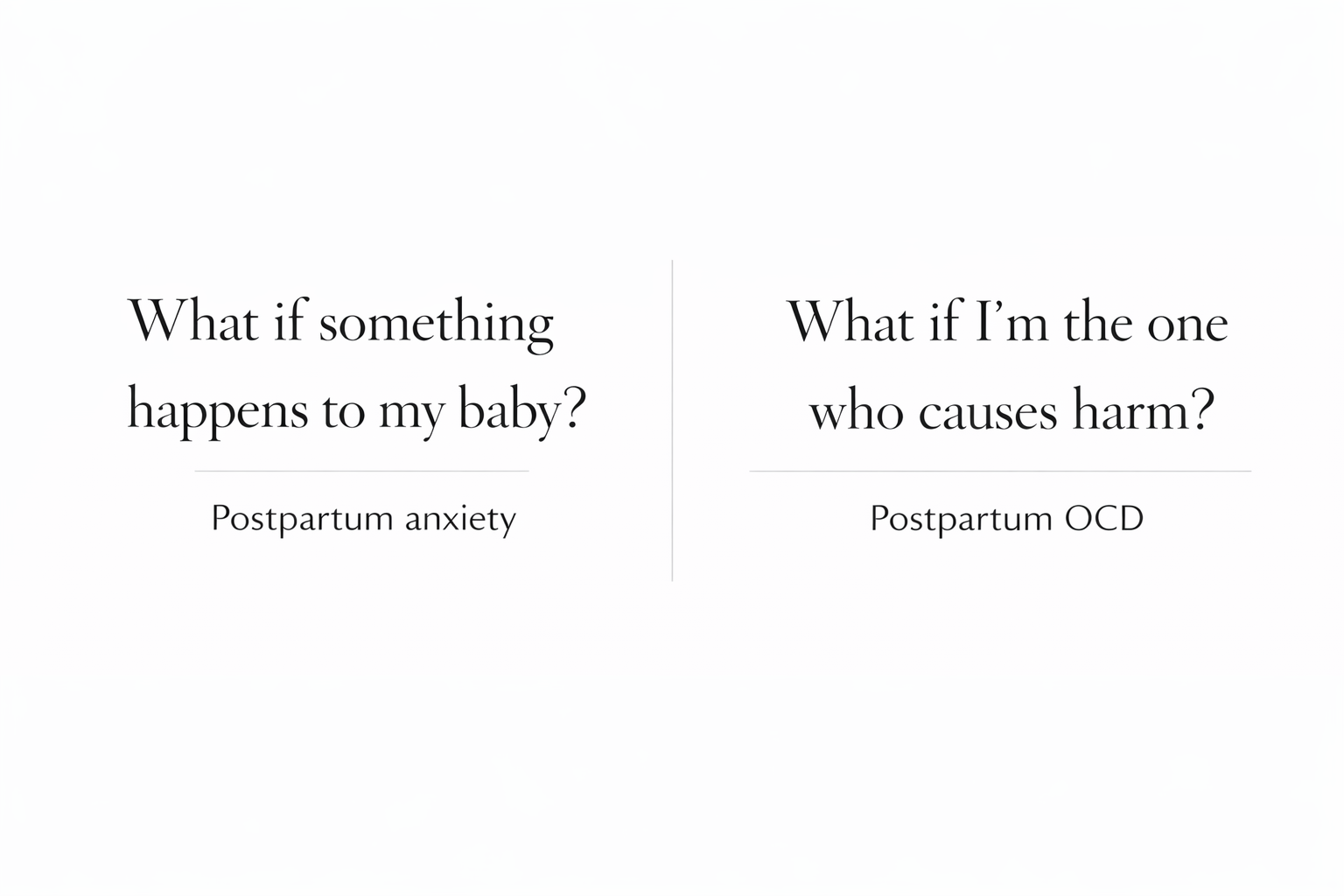
For many new parents, anxiety sounds like:
“What if something happens to my baby?”
But when the thoughts shift, they can start to sound more like:
“What if I’m the one who causes harm?”
That shift—from fear of something happening to your baby, to fear of something happening because of you—is often the point where things begin to feel much more intense.
Why This Matters
Many women are told they’re “just anxious,” and try to cope by thinking through the thoughts, reassuring themselves, or avoiding anything that feels risky.
But when these thoughts are part of OCD, those strategies can actually keep the cycle going.
The good news is that there is a highly effective, evidence-based treatment that helps break this pattern.
This is exactly what Exposure and Response Prevention (ERP) is designed to target—helping you step out of the reassurance cycle and retrain your brain’s response to these thoughts.
You Don’t Have to Stay Stuck in This
If your anxiety feels constant, intrusive, or hard to turn off, this is something we treat every day.
You don’t have to keep managing this on your own.
We specialize in helping new mothers work through intrusive thoughts and anxiety using evidence-based treatment—so you can get out of the loop and feel like yourself again.
We offer in-person sessions in Vienna, VA and work with clients across Virginia via telehealth, including those in McLean and the surrounding Northern Virginia area.
About the Author
Dr. Erin Cook is a clinical psychologist and co-founder of Red Elm Psychotherapy, a Virginia-based practice specializing in perinatal mental health and OCD. She works with women navigating pregnancy, postpartum, and early motherhood—especially when anxiety or intrusive thoughts feel overwhelming or out of character.
Her approach is collaborative, thoughtful, and grounded in helping clients understand what they’re experiencing and feel less alone in it.

Relationship OCD: Why You Can’t Stop Doubting Your Relationship
Relationship OCD can make normal doubt feel urgent, dangerous, and impossible to let go of. Learn how ROCD traps you in checking, comparison, reassurance-seeking, and “what if” loops — and how ERP therapy can help.
“What if I don’t actually love them?”
“What if I’m making a huge mistake?”
“Why am I constantly overanalyzing every single thing they say or do?”
Most people experience moments of doubt in a relationship. But for some, these questions don’t just pass—they loop. They intensify. They become a background noise that never truly shuts off, eventually taking over your daily life and your ability to enjoy your partner.
If your relationship feels less like a partnership and more like a puzzle you are desperately trying to "solve," you might be experiencing Relationship OCD (ROCD).
What Is Relationship OCD?
ROCD is a common subtype of Obsessive-Compulsive Disorder. It isn’t a sign that your relationship is "wrong" or that you’ve fallen out of love. Instead, it is a cycle driven by a low tolerance for uncertainty.
While everyone has fleeting doubts, someone with ROCD feels an urgent, crushing need for 100% certainty about their feelings, their partner’s flaws, or their long-term compatibility. Because perfect certainty is impossible to find, the brain stays stuck in a loop of searching for it.
Common Signs of ROCD
ROCD usually manifests through intrusive thoughts (obsessions) and the actions you take to quiet them (compulsions). You might find yourself:
Mentally Checking: Constantly asking yourself, "Do I feel 'the spark' right now?" while kissing or hanging out.
Comparing: Obsessively comparing your partner’s traits or your relationship to friends, exes, or even fictional characters.
Reassurance Seeking: Asking friends, family, or even your partner if you "seem" happy or if the relationship looks "right" to them.
Researching: Spending hours on forums or reading articles trying to find a definitive "sign" that you should stay or leave.
Hyper-fixating on Flaws: Becoming consumed by a partner’s physical "imperfections" or minor personality quirks as evidence that they aren't "The One."
Why It Feels So Real
The paradox of OCD is that it targets what you value most. If you didn’t care about your partner or the concept of love, your brain wouldn't bother using these thoughts to scare you.
Furthermore, ROCD exploits the fact that human emotions are naturally fluid. We don’t feel "madly in love" every second of every day. To an ROCD brain, a slight dip in affection isn't just a normal part of a Tuesday—it’s viewed as an emergency that must be analyzed immediately.
ROCD vs. Normal Doubt
How do you know if you're in the wrong relationship or if you just have OCD?
Normal Doubt
Comes and goes; usually triggered by specific, real-world issues.
Doesn't usually result in hours of "mental work" or research.
You can focus on other parts of your life (work, hobbies).
Feelings are generally stable despite the doubt.
Relationship OCD
Persistent, intrusive, and urgent.
Leads to repetitive compulsions to ease anxiety.
The doubt feels like a "cloud" over everything you do.
Feelings feel "gone" because anxiety is suppressing them.
The Cycle of ROCD
ROCD thrives on a specific loop:
The Trigger: A thought or feeling (e.g., “I didn’t miss them today”).
Anxiety: A spike of fear or "urgency" to figure out what that means.
Compulsion: You Google "signs of falling out of love" or check your feelings.
Temporary Relief: You feel better for a moment because you found an answer.
The Repeat: The doubt returns, and you need a stronger "fix."
There is a Way Out
The goal of therapy isn't to prove that your relationship is perfect—it’s to help you live comfortably with the fact that no relationship is certain.
Exposure and Response Prevention (ERP) is the gold standard for treating ROCD. It helps you break the cycle by teaching your brain that you don't have to "answer" every intrusive thought that pops into your head. You can learn to experience a doubt without letting it dictate your actions.
You don’t need to end your relationship to get relief, and you don’t need to reach 100% certainty before you start feeling better.
Take the Next Step
If this cycle feels familiar, you don’t have to keep trying to figure it out on your own. Our specialists are trained in evidence-based tools to help you reclaim your life from the "What Ifs."
Explore our Relationship OCD Service Page
Learn more about OCD Therapy
HowERP Therapyworks
You deserve to be present in your life, rather than stuck in your head.
About the Author
Dr. Niles Cook, PsyD is a licensed clinical psychologist and co-founder of Red Elm Psychotherapy. He specializes in the treatment of obsessive-compulsive disorder (OCD) and anxiety using Exposure and Response Prevention (ERP). Dr. Cook works with high-achieving adults and professionals who feel stuck in cycles of overthinking, doubt, and perfectionism. He provides telehealth therapy across Virginia. He is listed with the International OCD Foundation.