
When Being a "Good Mom" Feels Like a Prison: The Hidden Face of Postpartum OCD
By Dr. Erin Cook, PsyD, PMH-C | Red Elm Psychotherapy
It's 3:00 AM and your baby is finally asleep. Instead of resting, you're awake on Amazon comparing medical-grade sanitizing wipes for stroller wheels. You've already washed the pacifier four times tonight, your hands sting from the harsh soap, and your mind keeps whispering: “Just a few more steps and my baby will be safe.”
The next day, you tentatively mention your exhaustion to another mom. She smiles sympathetically and says, "Honestly, you can never be too careful these days. You're just such a good mom."
And suddenly, instead of recognizing how miserable you are, society accidentally reinforces the very clinical anxiety that is keeping you trapped.
How Anxiety Hides Behind "Good" Motherhood
One of the hardest parts about postpartum OCD (Obsessive-Compulsive Disorder) is that it constantly hides behind behaviors our culture celebrates. We praise mothers for sacrificing their sleep, admire moms who are endlessly vigilant, and celebrate the parent who has researched every chemical, anticipated every danger, and stayed one step ahead of every possible threat.
Our culture has created a difficult equation: we often celebrate constant hypervigilance as the mark of a devoted mother. It's easy to start believing that if you could just be careful enough, you could prevent every bad outcome.
Because of this cultural camouflage, it can be incredibly difficult to recognize when a healthy protective instinct has crossed the line into a clinical issue.
Imagine an adult without children washing every doorknob in their home fifty times a day because they're terrified of contamination. Most people would immediately recognize that as a sign of OCD. Now imagine a brand-new mother disinfecting every bottle, throwing away food because it might have touched a "dirty" counter, or spending hours tracking ambient air quality.
People call her responsible. Careful. Protective. Meanwhile, she is quietly unraveling inside.
The Trap of Postpartum Contamination OCD: Moving the Goalposts
Postpartum OCD has an exhausting way of convincing you that just one more precaution will finally grant you peace of mind. It tells you safety is just around the corner if you do:
One more Google search about infant illness.
One more boiling sterilization cycle for the pump parts.
One more frantic portal message to your pediatrician.
One more reassurance-seeking question to your partner.
But the relief never lasts. Within minutes, your brain finds another terrifying possibility, another looming uncertainty, or another microscopic threat you should have anticipated.
That is because OCD doesn't actually care about safety—it demands absolute certainty. And absolute certainty does not exist when you are raising a living, breathing human being in an unpredictable world.
Why Perinatal OCD Hijacks Your Best Instincts
"I just want to be a good mom and keep my baby safe."
In our Vienna, VA psychotherapy practice, this is the exact sentence Niles and I hear most often from suffering mothers. They don't want perfect floors or pristine houses; they want to protect their child.
That is what makes perinatal OCD so heartbreaking. It hijacks the most beautiful, fierce, instinctive part of being a parent—your desire to protect your baby—and slowly turns it into a psychological prison. Underneath your exhausting rituals isn't irrationality; there is profound love.
But OCD quietly adds one devastating, false assumption to that love: If something bad ever happens, it means you didn't do enough.
Good Parenting is Not Risk Elimination
Every parent makes hundreds of choices a day that involve inherent risk. We buckle our children into car seats—not because they make driving 100% safe, but because they make it safer. We hold their hand crossing a parking lot, knowing we still can't control every distracted driver.
Good parenting has never been about achieving zero risk. It is about making thoughtful decisions while accepting that some uncertainty remains.
There is no magical checklist that guarantees a child will never get sick. No amount of obsessive cleaning eliminates every environmental risk. OCD treats this natural human uncertainty like an emergency that must be solved right now, promising you that if you just wash longer or research harder, you'll finally earn the peace you long for.
The goalpost will always move.
Because the goal of motherhood isn't becoming certain.
The goal of motherhood is learning to love deeply in a world where certainty doesn't exist.
You were never meant to carry the impossible responsibility of guaranteeing your child's safety. No parent can.
What ERP Therapy Actually Looks Like at Red Elm Psychotherapy
Many moms avoid reaching out for help because they are terrified of what treatment entails. They worry a therapist is going to force them to stop caring about germs altogether, or command them to be "gross" or reckless with their baby.
As specialized ERP clinicians, we want you to know: That is not what treatment looks like.
Exposure and Response Prevention (ERP), the gold-standard evidence-based treatment for OCD, isn't about becoming careless. It doesn't ask you to ignore legitimate pediatric health recommendations. Instead, it helps you build the skills to notice when anxiety—not your actual parenting values—is calling the shots.
Healthy caution asks:
"Have I taken reasonable, common-sense steps to care for my baby?"Postpartum OCD asks:
"But how can I be 100% absolutely sure there isn't a single germ left?"
ERP helps you learn to recognize the difference.
ERP helps you tell the difference. Recovery isn't about caring less about your child. It's about no longer confusing certainty with love.
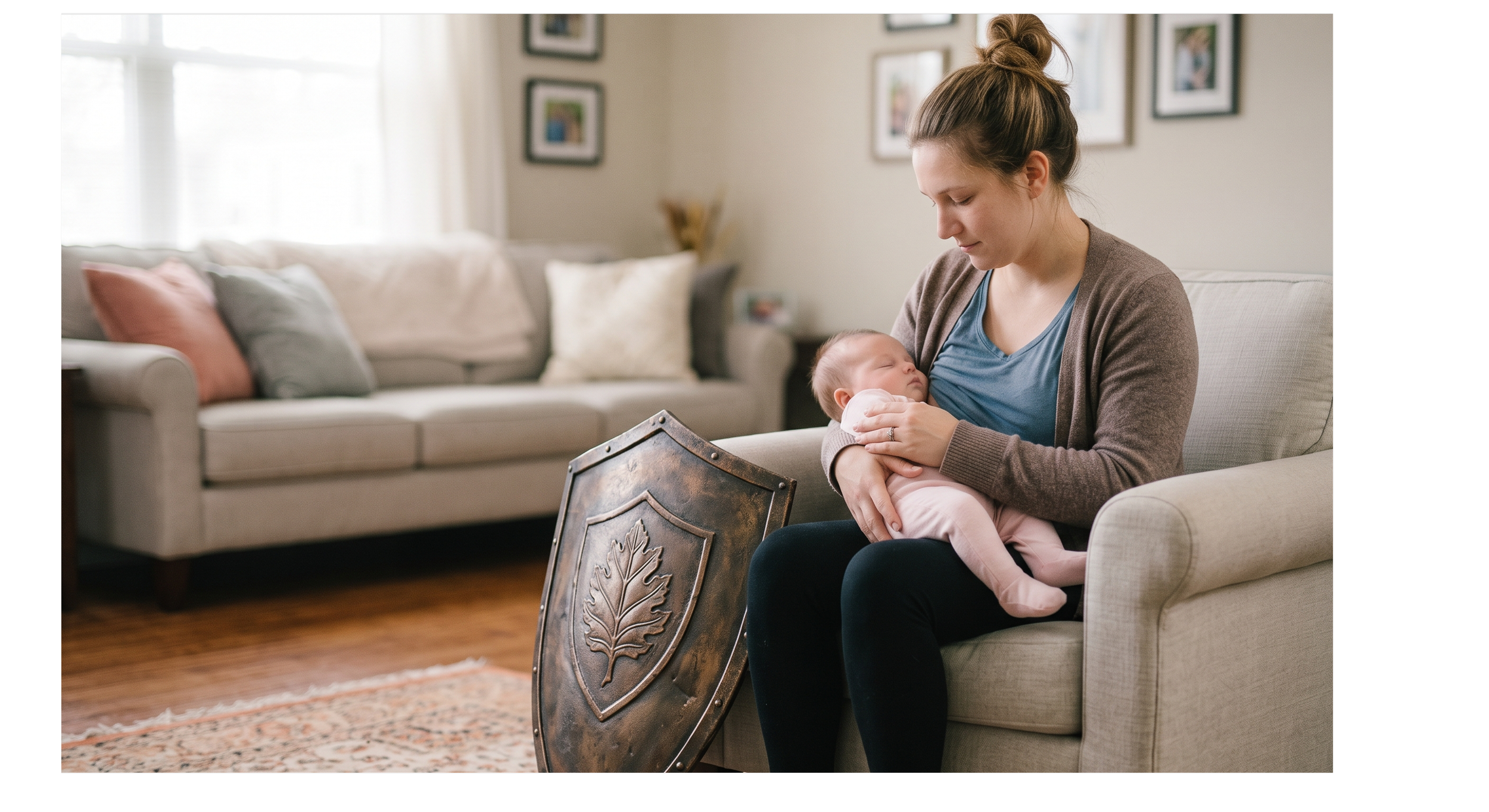
Putting Down the Shield
Think of your postpartum anxiety like carrying a massive, heavy iron shield. At first, it made perfect sense to pick it up. Of course you want to protect your newborn.
But over time, OCD convinces you that you can never set that shield down. You sleep with it. You eat with it. You end up holding your baby awkwardly with one arm because your other arm is always white-knuckled, gripping the heavy shield. Eventually, the very tool meant to protect your family becomes the weight that keeps you from fully living.
ERP therapy doesn't ask you to abandon your child's safety. It simply helps you put the shield down when anxiety—not actual danger—is demanding you carry it. Because when your hands aren't occupied by fear, they are finally free to hold your baby, to rest, and to notice the beautiful moments that OCD has been stealing from you.
Postpartum OCD Therapy in Vienna, Virginia & Across PSYPACT States
If your "good mom" habits have started to feel like a prison, you do not have to keep carrying this weight alone.
At Red Elm Psychotherapy, we specialize in helping mothers recover from the exhausting cycles of postpartum OCD and perinatal anxiety using evidence-based, compassionate ERP. We provide specialized, non-judgmental care tailored to the unique pressures of motherhood.
We offer in-person therapy sessions at our office in Vienna, Virginia, as well as convenient virtual teletherapy across Virginia and multiple states via PSYPACT.
Recovery isn't about becoming a less careful mother—it’s about becoming a free one. Let's work together to help you put down the shield and start enjoying your baby again.