
Face Your Fears, Change Your Brain: What to Expect in ERP Therapy for OCD
If you’re searching for ERP therapy for OCD in Virginia, you may already know what it feels like to be stuck in the OCD cycle.
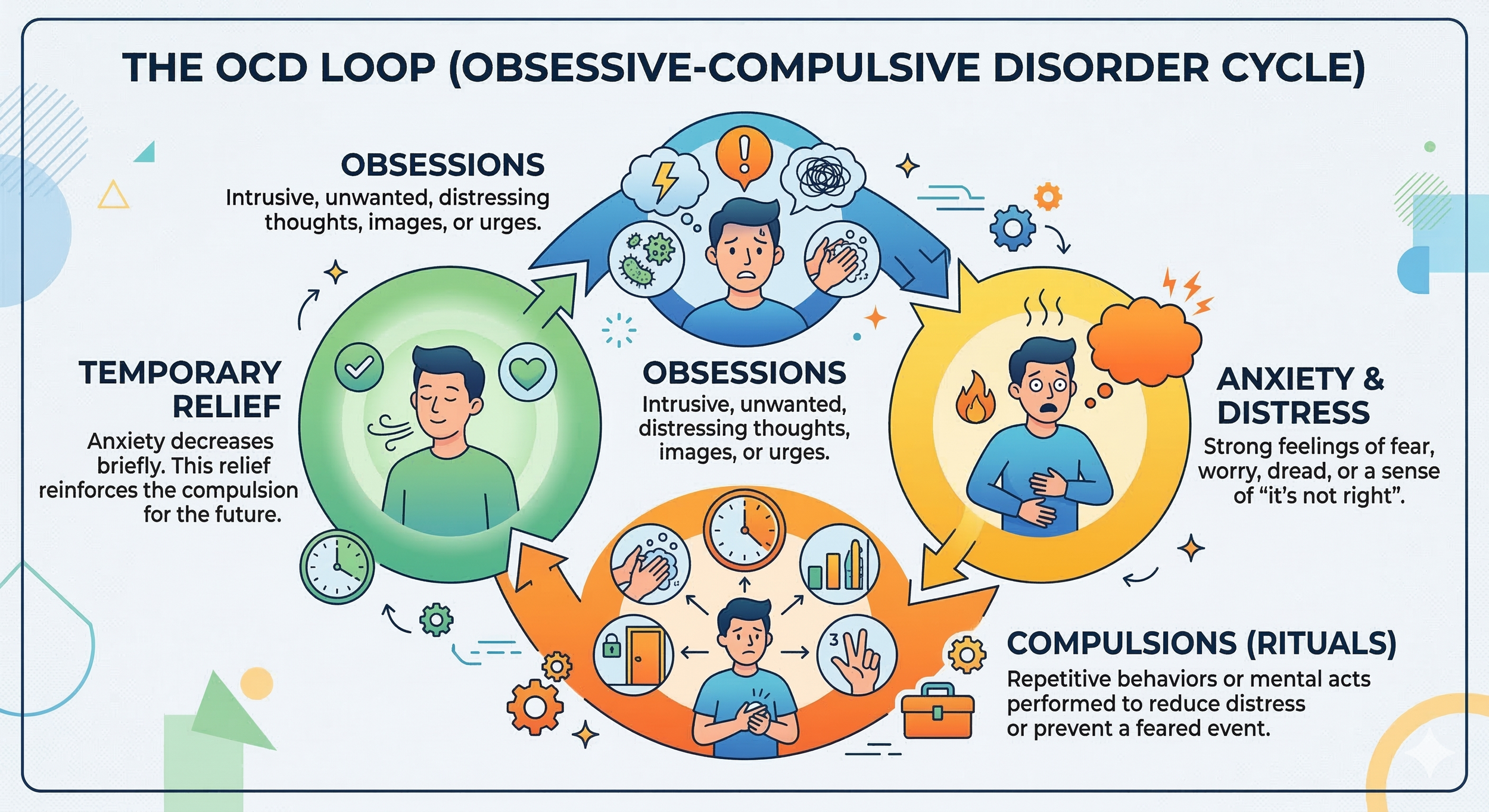
A thought shows up.
Your anxiety spikes.
Your brain tells you that you need to figure it out, prevent something bad from happening, or get reassurance before you can move on.
Maybe you find yourself:
Asking others for reassurance again and again
Avoiding situations that feel unsafe
Mentally reviewing conversations, memories, or decisions
Trying to “cancel out” intrusive thoughts
Checking until something finally feels right
These strategies make sense. They are your brain’s attempt to protect you.
The problem is that OCD learns from what you do next. Every time you respond to anxiety with a compulsion, your brain gets the message:
"This thought must have been important. I needed to do something to feel safe."
Over time, the cycle becomes stronger.
Exposure and Response Prevention (ERP) therapy helps your brain learn a different message:
"I can experience uncertainty. I can feel anxiety. I can have an intrusive thought—and I do not have to respond to it."
At Red Elm Psychotherapy, we specialize in ERP therapy for OCD, intrusive thoughts, and perinatal OCD, serving clients across Virginia and through PSYPACT telehealth.
What Is ERP Therapy for OCD?
Exposure and Response Prevention (ERP) is a specialized form of cognitive behavioral therapy designed specifically to treat OCD.
The name can sound intimidating. Many people hear “exposure” and imagine being forced to face their biggest fear immediately.
That is not what good ERP looks like.
ERP is a collaborative process where you and your therapist identify the patterns that keep OCD going and gradually practice responding differently.
The goal is not to eliminate anxiety forever.
The goal is to stop letting anxiety and OCD make your decisions for you.
ERP involves two parts:
Exposure: Gently and intentionally approaching thoughts, situations, sensations, or uncertainties that OCD tells you to avoid.
Response Prevention: Practicing not engaging in compulsions that temporarily reduce anxiety but keep OCD stuck over time.
What Happens in ERP Therapy?
Understanding Your OCD Cycle
Before starting ERP, your therapist will help you understand how OCD is keeping you stuck.
Together, you’ll look at the thoughts or fears that trigger anxiety and the things you do afterward to try to feel safe or certain.
For many people, those responses are not obvious. They may look like checking, asking for reassurance, avoiding situations, or spending hours trying to analyze a thought until it finally feels resolved.
The problem is that OCD keeps moving the finish line. No amount of checking, analyzing, or reassurance can create the complete certainty OCD is demanding.
ERP helps you begin stepping out of that cycle.Creating a Personalized Exposure Plan
ERP does not mean walking into your biggest fear on the first day of therapy.
Instead, you and your therapist create a gradual plan for practicing uncertainty. This might include approaching situations you have been avoiding, allowing uncomfortable thoughts to be present, or practicing not engaging in the rituals that OCD demands.
The objective is to help you discover that you can experience discomfort and still safely move forward
Learning to Respond Differently
This is the heart of ERP.
When OCD shows up, it often creates a sense of urgency:
"You need to figure this out right now."
"You need to make sure."
"You cannot move on until you feel certain."
ERP helps you practice a different response.
Instead of:
"How do I make this anxiety go away?"
you learn:
"Can I allow this feeling to be here while continuing with my life?"
This might mean resisting the urge to check, avoiding reassurance seeking, or allowing an intrusive thought to exist without trying to analyze what it means.
Over time, your brain learns that anxiety is uncomfortable—but it is not an emergency.
What Changes With ERP?
Over time, many people notice that OCD begins to take up less space.
You may find yourself:
Spending less time analyzing and seeking reassurance
Feeling less controlled by intrusive thoughts
Making decisions based on your values instead of fear
Anxiety and fear can come up, but they no longer make the rules.
ERP Therapy for Perinatal OCD: When Intrusive Thoughts Feel Terrifying
Perinatal OCD can show up as frightening intrusive thoughts, intense guilt, repeated reassurance seeking, or avoiding situations that feel risky. Many mothers find themselves caught in a cycle of trying to prove they are safe, responsible, and "good enough"-but the search for certainty never quite ends.
A Perinatal OCD Example
Many mothers with perinatal OCD describe an experience like this:
After the birth of her baby, a mother begins experiencing intrusive thoughts about something terrible happening. The thoughts feel vivid, unwanted, and deeply upsetting.
She starts wondering:
"What if this thought means something? What if I can't trust myself?"
She begins avoiding situations that trigger anxiety, asking her partner for reassurance, and mentally reviewing moments to figure out whether she missed something.
What makes ERP feel so difficult is not just the anxiety.
It is the feeling that not responding to the thoughts would be irresponsible.
"If there is even a small chance something could happen, shouldn't I do everything I can to prevent it?"
This fear is one reason perinatal OCD can feel so convincing.
Mothers are often surrounded by messages that they should anticipate every possible danger, prevent every mistake, and always know the right thing to do. OCD can take that understandable desire to protect and turn it into an impossible demand for certainty.
In ERP, the goal is not to prove that nothing bad could ever happen.
Instead, therapy focuses on learning that intrusive thoughts are not warnings or commands.
For example, an exposure might involve allowing an intrusive thought to be present during a normal parenting activity while practicing not engaging in compulsions that keep OCD going—such as reassurance seeking, mental reviewing, or avoidance.
The goal is not to become careless.
The goal is to learn that you can be a caring, responsible mother without needing absolute certainty before you trust yourself.
Over time, many mothers find that the thoughts become less urgent, and they are able to spend more time being present with their babies instead of constantly trying to prevent imagined dangers.
This is a fictional example created to illustrate how perinatal OCD can show up and how ERP therapy works.
ERP Therapy in Virginia and Through PSYPACT Telehealth
Finding specialized OCD treatment can be challenging. Many therapists are trained in general anxiety treatment but do not have specific training in ERP.
At Red Elm Psychotherapy, we provide:
OCD therapy in Vienna, VA
ERP therapy for OCD in Northern Virginia
Virtual ERP therapy across participating PSYPACT states
Specialized treatment for perinatal OCD and intrusive thoughts
You do not have to spend years trying to outthink OCD.
Start ERP Therapy for OCD in Virginia
If you are struggling with OCD, intrusive thoughts, or perinatal OCD, therapy can help you break free from the cycle of fear and compulsions.
Starting ERP can feel intimidating—but you do not have to feel completely ready before reaching out.
Many people begin therapy feeling unsure, scared, or convinced their thoughts are different from everyone else’s.
You are not the first person to bring these fears into therapy.
At Red Elm Psychotherapy, we provide compassionate, specialized ERP therapy for OCD across Virginia and through PSYPACT telehealth.
Schedule a consultation to learn how ERP therapy can help you move toward a life that is guided by your values—not by OCD.